Rats or voles – two different rodents
If your root vegetables have been gnawed on, someone has been helping themselves to your food supplies, or you simply hear rustling or nibbling noises, it is very likely that you have rodents visiting your home. At first glance, it may not always be clear whether they are rats or voles. We explain the differences below.
- When we talk about a rat, we usually mean the brown rat (Rattus norvegicus). The house rat (Rattus rattus), on the other hand, is rarely encountered. It is now even classified as an endangered species in Germany.
- Brown rats are relatively large members of the mouse family, reaching a length of up to 25 centimeters. In addition, they have an almost hairless tail that is about 20 centimeters long. Adult animals weigh around 300 grams. Their ears are clearly visible.
- Their color can vary from gray-brown to rust-brown. Some animals are almost black. These intelligent rodents are slightly lighter in color on their belly than on their back. The rat’s body is elongated and torpedo-shaped.
- As crepuscular animals, rats can mainly be heard in the evening and early night. For example, if they live in your attic or garage. Typical sounds include the pattering of their feet as they run and a crunching noise when they eat or gnaw on something.
- Rats are social animals and usually live in stable groups. If you see a rat, you can assume that there are several animals on your property. Rat droppings are about 1.5 cm long and slightly curved.
The vole – often an unwelcome guest in the garden
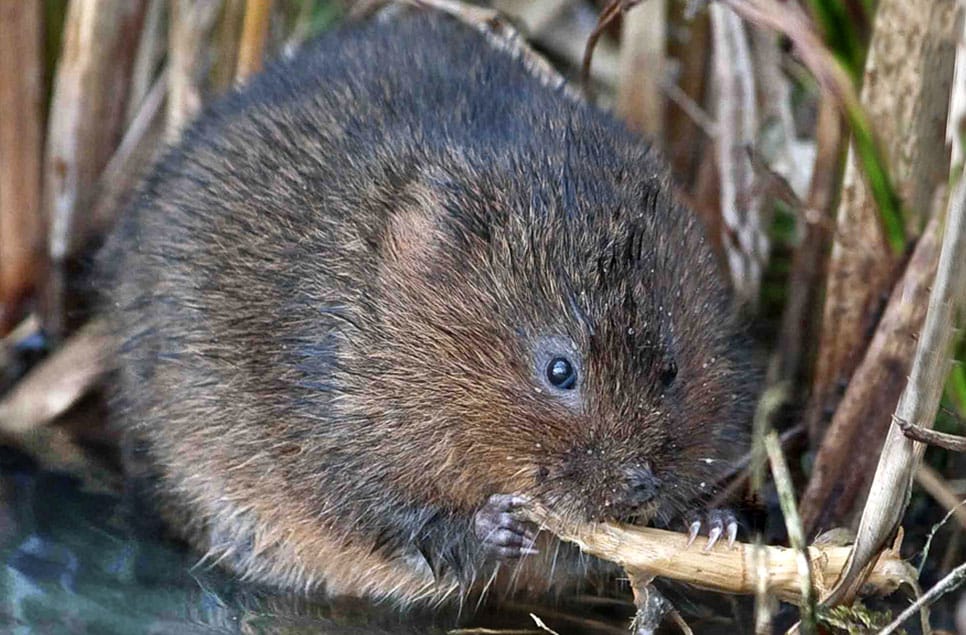
There is no such thing as “the” vole. The vole group comprises a large family that includes field mice, water voles, and lemmings, for example. In domestic gardens, we usually encounter the water vole (Arvicola terrestis). Let us introduce it to you:
- Unlike the brown rat, the water vole is a rather small representative of the mouse family. Its body is only about 15 centimeters long, and its tail, at just under 6 centimeters, is significantly shorter than that of a full-grown rat. It weighs between 80 and 100 grams. Its ears are tiny.
- Its fur is reddish brown to dark brown. Very dark animals, which are black-brown in color, are also occasionally found. Overall, the fur appears very velvety. The body resembles that of a small roller.
- Voles are rarely seen above ground and live almost exclusively in their tunnels and underground burrows. They can be recognized by above-ground mounds that resemble those of a mole.
- Outside of mating season, the vole does not pay much attention to other voles and lives mainly as a solitary animal. Nevertheless, numerous representatives of this mouse species can live side by side on a single piece of land. Their droppings are only slightly larger than a pinhead.

Recognizing rats or voles: Tips for identification
As described above, rats and voles are usually easy to distinguish by their appearance. However, these shy animals usually do not show themselves. But rats and voles can also be identified by their tracks.
- Voles live underground and leave behind typical earthy mounds with sideways-shifted tunnels. Unlike moles, the tunnels are flatter and the exit hole is on the side, not in the middle. They also often gnaw on the roots and bark of fruit trees and vegetables. They are practically never found in houses. The feeding marks are smooth and even.
- Rats often live in buildings, basements, or near pet feeding areas. Their droppings are often found along walls or in corners. Rats also leave drag marks with their tails and make nibbling noises. Bite marks are often coarser and more irregular, e.g., on packaging or waste.
- If you are unsure whether you are dealing with rats or voles despite the traces, you should consult a specialist. Trained pest controllers can not only help with identification, but can also assist you in getting rid of the pests.
Controlling rats and voles: Measures and legal framework
Rats and voles can cause considerable damage – whether by eating plants and food supplies or by transmitting diseases. Targeted control is therefore necessary in certain cases, but is subject to clear legal requirements in Germany.
- The control of rats is particularly strictly regulated in Germany, as they are considered a health risk. In many federal states, rat infestations must be reported – especially in municipal facilities, residential complexes, or food processing businesses. The local public order or health authorities are usually responsible for this.
- Private individuals may only use certain means of control. Since 2018, the use of rodenticides (rat poison) has only been permitted to a limited extent: many preparations are subject to approval and may only be used by trained specialists. Mechanical traps, secure waste storage, sealing of buildings, and hygienic measures are the preferred means of prevention and control.
- Voles, such as the water vole, are considered plant pests – especially in gardening and fruit growing. Their control is permitted, but they should not be confused with moles, which are protected by law and may not be controlled. Permitted measures against voles include live and snap traps, repellents (e.g., butyric acid), and fumigation of the tunnels.
- A much gentler and more animal-friendly approach is to plant plants that voles do not like. These include garlic, imperial crowns, and sweet clover. The animals avoid these smells. Alternatively, sensitive plants can also be protected from damage by voles with vole screens.