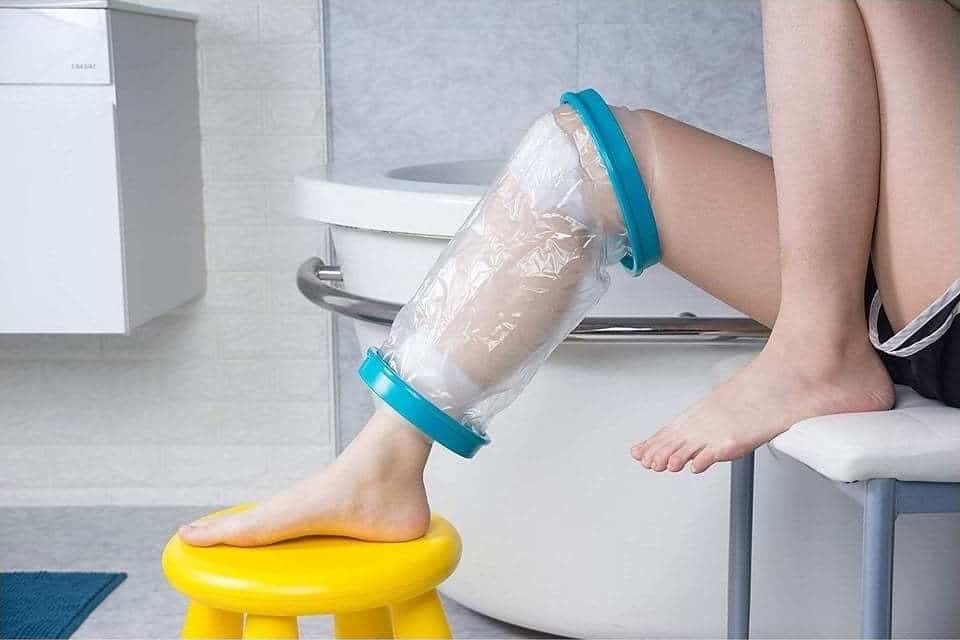
Showering with a cast—use these covering options
Even if you have broken your arm, you still need to take care of your personal hygiene. Showering is one of the most common cleansing rituals nowadays. With a cast, this can be a challenge.
- Protective cover: Not exactly cheap, but effective is the protective cover. You can buy it at the pharmacy, or your doctor may give you one. The cover is nothing more than a long tube made of waterproof material. The material is very durable and sealed watertight at the bottom.
- Slide the cover over the arm or leg in the cast. Once you have reached the end of the cast, attach the pump provided and suck the air out. This seals the cast, allowing you to even go swimming. There are also models without a pump.
- Plastic bag: Not quite as sturdy, but following the same principle, you can also use a plastic bag. Pull the bag over the cast and seal the top opening with a rubber band or a strong band.
- You can also use adhesive tape. However, it should be a waterproof variety. Sealing tape, which is also used in house construction, is best suited for this purpose.
- Cling film: Cling film (food wrap) can do the same thing as a plastic bag. It is important that you wrap the film tightly around the arm or leg with the plaster cast. No holes should be torn. With this option, adhesive tape must be used on both arms.
Shower aids
To shower safely, we recommend that you sit down while showering.
- Place a chair or stool in the shower. For practical reasons, this should be made of plastic. A garden chair is best suited for use in the home.
- The chair can also slip, so you need to secure it as well. Place a large towel or bath mat underneath it to solve this problem. It is best to have a healthy person test whether everything is secure enough first.
- If you have broken your leg, you should enter the shower with crutches. Lower yourself onto the chair. Hold on to a grab bar in the shower. If there is no grab bar, use the back of the chair or keep a walking aid in the shower cubicle while showering.
- Try to keep your broken arm or leg away from the water with protective film. Depending on the type of film you choose, you should still expect water to penetrate. Therefore, you should only turn the shower on at half strength and set it to a soft spray.
- Dry yourself while sitting down and ask for help getting out of the shower cubicle after showering. This is definitely safer, as there may be water everywhere, which poses a slipping hazard. This will prevent you from slipping and breaking another limb.
Alternative to plastic wrap: bathtub
If you are not convinced by the plastic wrap options, there are alternatives. It is not uncommon for plastic wrap to tear and water to run under the cast. In the worst case, this can lead to skin infections if the damp cast has to remain on the skin for a longer period of time.
- Instead of showering, you might want to consider taking a bath. Whether you have broken your arm or your leg, simply keep the bandaged limb out of the tub.
- As a precaution, you can wrap a towel around the limb to protect it from splashing water.
Rest the limb on the edge of the tub or on a stool next to the tub.
- To ensure that you can get in and out of the tub safely, you should ask someone else to help you if you want to take a bath.
- You can also take a shower in the bathtub. Keep your arm or leg away from the shower head as described. Again, it may be helpful to have someone assist you.

Alternative to the plastic sheet: sink or washbasin
An even safer way to get water on your cast is to wash yourself at the sink. If your bathroom is too small for this, you can also fill a large bowl with water and wash yourself at the table.
- You can now sit comfortably on a sturdy chair. This reduces the risk of slipping. Lay out all the necessary items in advance.
- Use a washcloth or bath sponge to wash yourself. Wring it out well so that the water does not run down your body.
- A shower offers the advantage of allowing you to run the water over your body. This is not possible when washing at the sink. Ask someone you trust to help you with your back and feet.
The waterproof plaster cast
Depending on your health insurance, you can choose between different options for your plaster cast. The simplest option, which is covered by all statutory health insurance companies, is the classic plaster cast, which must not get wet.
- However, there is also a waterproof plaster cast. Ask your doctor if they can apply one for you. Since statutory health insurance companies do not cover the costs for this, it is worth asking about the price.
- If the additional costs are affordable for you, consider whether the cast is worth it. For example, if you want to go on vacation and do a lot of swimming, it may be worth it. This way, you don’t have to wrap the plaster cast in plastic every day.
- In general, you should also ask your doctor what activities are possible with the waterproof cast. Some materials are excellent and allow you to take a bath. Others only offer general water protection.