349
What a galaxy is can be explained quite easily. Looking up at the night sky helps to understand. Imagining the size of a galaxy, on the other hand, is much more difficult.
What is a galaxy? Simply explained for children
A galaxy is also called the Milky Way. Galaxies are held together by gravity.
- If you look up at the sky on a cloudless night, you can see parts of the galaxy we live in. A galaxy is a collection of stars.
- A galaxy consists of numerous stars, i.e., suns. Our sun is just one star in our galaxy. It also includes vast numbers of planets that orbit a sun, such as our planet, Earth.
- So, various suns shine in the night sky. These also illuminate planets, so that they can be seen even though they do not emit any light themselves.
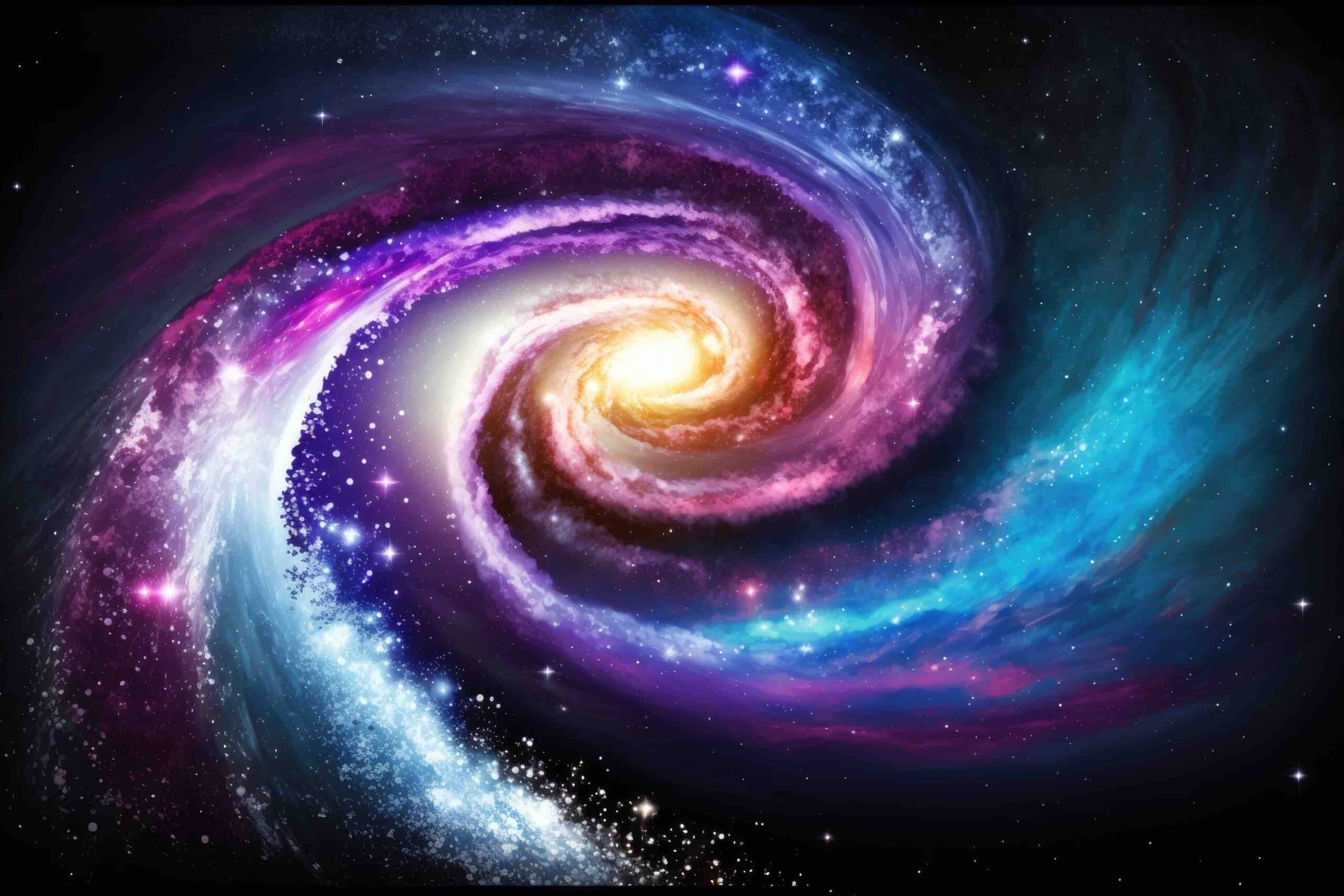
- A galaxy is huge, containing billions of stars. These stars all orbit around the center of a galaxy. The orbits of the stars around the center form a rotating disc. A galaxy is therefore usually spiral-shaped. The center of a galaxy forms a black hole.
- However, there are also other shapes, such as elliptical galaxies or irregular galaxies, in which the stars are clustered together without a specific structure.
A galaxy has unimaginable dimensions
Our Earth is just a tiny speck in our galaxy.
- As already mentioned, a galaxy consists of billions of suns. An average-sized galaxy has approximately 100 billion stars.
- The Milky Way, in which we live, has a diameter of approximately 200,000 light-years. To better understand this, one light-year is approximately 9.5 trillion kilometers.
- No one knows exactly how many galaxies there are in total. The universe is too big for us to know everything about it. It used to be assumed that there were around 100 billion galaxies. However, after evaluating the information collected by the Hubble Telescope, it was concluded that this number is only a tenth of the actual number. It is now assumed that there are more than a trillion Milky Ways.
- If we compare the size of the universe to our galaxy, it is only a small dot in the entire universe. If we further consider that our sun is only one of 250 billion other suns in our Milky Way, the dimension becomes more vivid, if not easier to imagine.
- If you are now wondering about the size ratio between our sun and the Earth, we will explain in the next article how many times the Earth fits into the sun.

What types of galaxies are there? An overview of the different types
The three main types of galaxies can be described as follows:
- Spiral galaxies: They have a disc-shaped structure with typically visible spiral arms consisting of stars, gas, and dust. The center, known as the bulge, contains older stars and is spheroidal. Spiral galaxies contain a lot of gas and dust, which enables continuous star formation. The spiral arms appear bluish due to young, bright stars.
- The stars usually move in an orderly fashion in the rotating disk. The Milky Way is a typical barred spiral, a subtype with a bar of stars in the center from which the spiral arms extend. Spiral galaxies are dynamic systems with active star formation (e.g., formation of new stars from molecular clouds in the spiral arms).
- Elliptical galaxies: These galaxies have an oval or spherical shape and show little internal structure. They consist mainly of older stars and contain little gas and dust, so that almost no new stars are formed there. The stars move predominantly in random orbits, resulting in a homogeneous distribution. Elliptical galaxies often occur in galaxy clusters and are often larger and older. One example is the galaxy M87 with a supermassive black hole at its center.
- Irregular galaxies: They do not have a clear shape or structure like spiral or elliptical galaxies. Irregular galaxies often contain a lot of gas, which also leads to active star formation. They can be the result of gravitational interactions or collisions and show chaotic star distributions without symmetrical spiral arms or a clearly defined bulge.
- In addition, there are supermassive black holes in the centers of galaxies. It is now considered certain that almost every large galaxy, including the Milky Way, has a supermassive black hole at its center. These black holes have masses ranging from millions to billions of solar masses. There are also satellite galaxies such as the Magellanic Clouds.