Reading your water meter is important for keeping track of your water consumption and avoiding unpleasant surprises when you receive your bill. We will show you step by step how to read your water meter correctly and what details you need to pay particular attention to.
Reading your water meter yourself: How to find the meters
Your water meters may be located throughout your home or centrally in the basement. The locations and number of meters vary from house to house. Here’s how to find your water meters and make sure you’ve found them all:
- In apartments, water meters are usually located in the kitchen, bathroom, and toilet. Sometimes the meters are located on the riser pipe in the basement. This also includes garden water meters, if you have them installed.
- In a single-family home, the meters are more often located at the main water tap. You will find this in the basement or utility room.
- If you are unsure whether you have found all your water meters, check your last water bill. All your meters are listed here.
- If one of your water meters is in a built-in cupboard, blocked or difficult to reach for other reasons, you don’t need to struggle to get into the furthest corners to read it. Simply take a photo of the water meter from the front with a flash and then read it comfortably from the display. For meters that are deeply recessed, a self-timer and selfie stick can help, for example.
Reading meters manually: How to proceed
Once you have located your water meters, it’s time to read them. To read the meter number, hot water/cold water, and water consumption, proceed as follows:
- First, note down the water meter number. This is usually located in the upper part of the water meter and is marked “WZ.-Nr.” (see point 1 in the image).
- Whether it is a hot or cold water meter is usually color-coded: a red border around the meter reading indicates hot water, blue indicates cold water (point 2 in the image).
- The meter reading on your water meter is given in cubic meters (m³). 1 m³ corresponds to 1000 liters. Only whole cubic meters are relevant for determining the advance payments to the waterworks, so in the photo shown, the reading is 24 (point 3 in the image).
- The decimal places are either separated by a comma and shown in a different color on the main display, or they can be read off small gears.
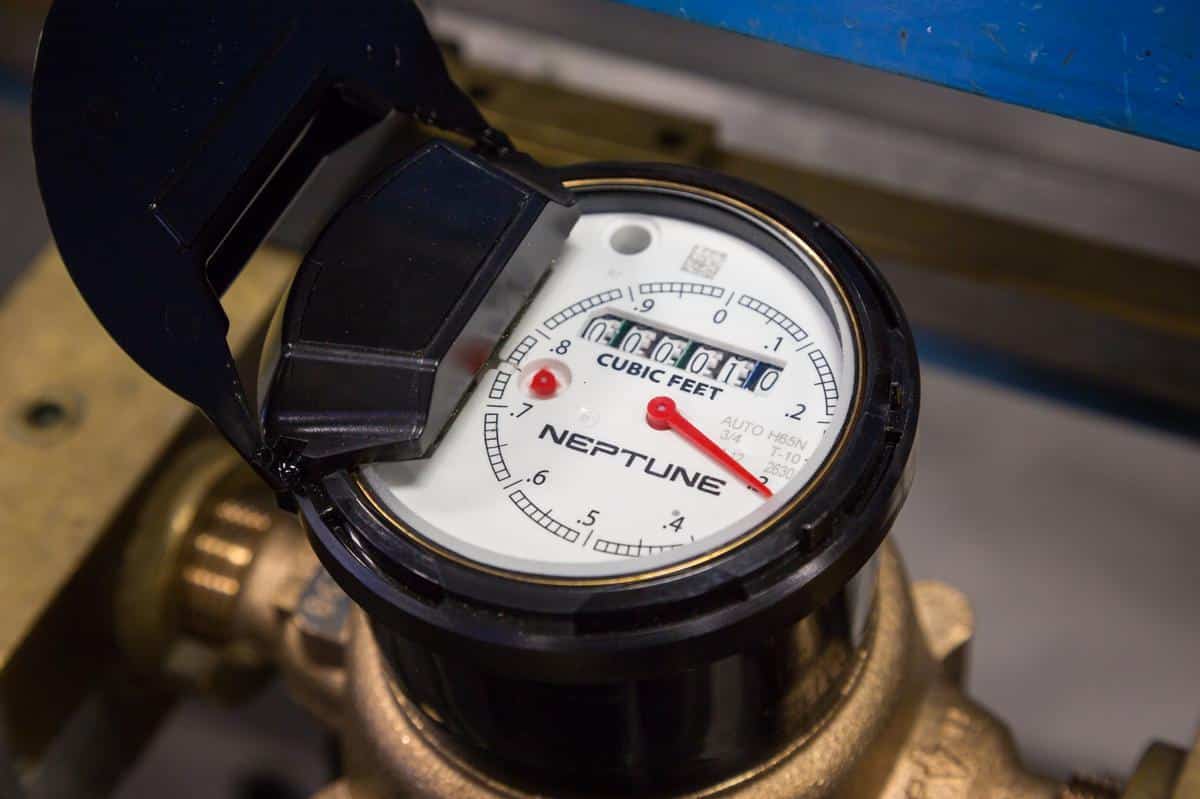
- As can be seen in the photo, there is often a combination of a number display and gears. The number gears are usually divided into 10 parts, which you can number clockwise. The gear wheel in the photo shows 3.5 × 0.0001 = 0.00035.
- The meter reading in the photo is therefore 24.25335 m³ (point 4 in the image).
- We provide you with a free Excel file to make it easy to calculate your water and electricity consumption costs.
- If you report lower consumption to the waterworks, you will have to pay the difference when you move out, at the latest, for the final reading. With a bit of bad luck, the water costs will have risen significantly by then.
Modern solutions: Reading digital and radio-based water meters
There are various modern solutions for reading water meters by radio or online, which differ in terms of convenience, technology, and area of application. Remote reading is technically mature and offers numerous advantages for owners, managers, and residents. The choice of the right solution depends on the structural conditions, the desired degree of automation, and the legal requirements. You must register your water meter when you move in.
- Modern water meters are usually equipped with an integrated radio module. They store consumption data and send it at regular intervals by radio to a receiver or directly to a central data center. The transmission is encrypted and can take place daily, bi-monthly, or monthly, depending on the system. The data is made available online so that it can be accessed by utilities or administrators.
- With walk-by/drive-by reading, the water meter stores the consumption data in the radio module. A meter reader can wirelessly collect the data with a mobile reading device while walking (walk-by) or driving (drive-by) past, without having to enter the building. Depending on the technology, the range of the radio transmission can be up to several kilometers, so that even meters that are difficult to access (e.g., in the basement) can be read without any problems.
- With stationary remote reading, the consumption data is automatically and regularly transmitted to a central server or online portal via a permanently installed network (e.g., with data collectors in the building). The data can then be viewed and processed online by authorized persons (e.g., property managers).
- Mechanical water meters can also be retrofitted with radio modules or pulse modules to integrate them into remote reading systems. Wired solutions such as M-Bus or pulse generator modules are further options for transmitting data digitally.
- Almost all utilities offer digital portals or apps where users can read their own water meter readings and submit them online. The meter display shows the current consumption, which is then entered manually.

When to read the water meter? Important reading times
Water meters are usually read once a year to record individual water consumption for the annual bill. This applies to both mechanical and digital water meters. Many suppliers now use radio or online reading, which usually eliminates the need for on-site reading and allows data to be transmitted automatically or remotely.
- The annual reading is standard and is used to prepare the consumption bill. The reading can be taken either by the utility company, a contracted service provider, or by the tenant themselves. With radio meters, the personal reading appointment is usually completely eliminated.
- In addition to the regular annual reading, there are special occasions when an interim reading is required, such as when there is a change of tenant or owner. In these cases, the meter reading is taken on the day of moving out or on the last day of the tenancy to ensure that consumption costs are allocated correctly.
- The basic obligation to take annual readings and interim readings when tenants change applies nationwide, but the specific organization (e.g., self-reading, reading card, radio reading) may vary depending on the supplier. For inaccessible apartments, alternative appointments are offered or consumption is estimated if no reading is possible.
Practical tips and tricks for reading water meters
If people have difficulty reading their water meter—for example, because they cannot read, are visually impaired, or have other limitations—there are various solutions and recommended procedures. This also applies if a meter is defective.
- Anyone who is unable to read the meter themselves should ask someone close to them (e.g., relatives, neighbors, caregivers) for assistance. Alternatively, the responsible water supplier or property management company can be contacted to arrange for a personal reading by an employee.
- People with reading difficulties can take a photo of the meter reading and send it to the supplier. Many suppliers accept photos as proof of reading. In such cases, modern water meters with radio or online reading can also help, as they do not require manual reading.
- If a water meter is defective, this must be reported immediately to the water supplier or network operator. The contact details (phone number or email) can often be found on the supplier’s website or on the last bill.
- A meter is considered defective if the counter stops, unusual noises occur, the display fails, the meter is no longer readable, or it leaks. If the meter does not count when the water is running, it is also defective.
- The water supplier is generally responsible for the installation, replacement, and maintenance of the water meter. After the report, a technician is usually sent to check the meter and replace it if necessary.
- If a measurement error is suspected, the meter can also be checked by a specialist company. The deviation for cold water meters may not exceed ±10 percent.
Legal requirements for reading water meters
Since the amendment to the Heating Costs Ordinance and the implementation of EU energy saving requirements, there are new legal rules in Germany for reading water meters. This applies in particular to devices that can be read remotely.
- Since December 1, 2021, only remotely readable water meters may be newly installed. By December 31, 2026, at the latest, all existing meters must be converted to remotely readable models. Consumption must be recorded at least once a month to ensure accurate and transparent billing, as required by the EU Energy Efficiency Directive (EED) and the Heating Costs Ordinance.
- If the meter reading is not reported or recorded (for example, because the required technology has not been installed), there may be legal consequences. Violations can be punished as administrative offenses and result in fines. If the meter reading is not transmitted on time or if it is not possible to read the meter, the utility company or property management company may estimate consumption.
- However, there are exceptions. In rare cases, retrofitting may be waived if it is not technically or economically reasonable. This must be examined and documented on a case-by-case basis in accordance with the Heating Costs Ordinance (§ 11 HKVO).
- The obligation to install cold water meters is regulated in the state building codes and is not uniform throughout Germany. However, the remote reading obligation applies to all hot water meters in central systems with consumption-based billing.