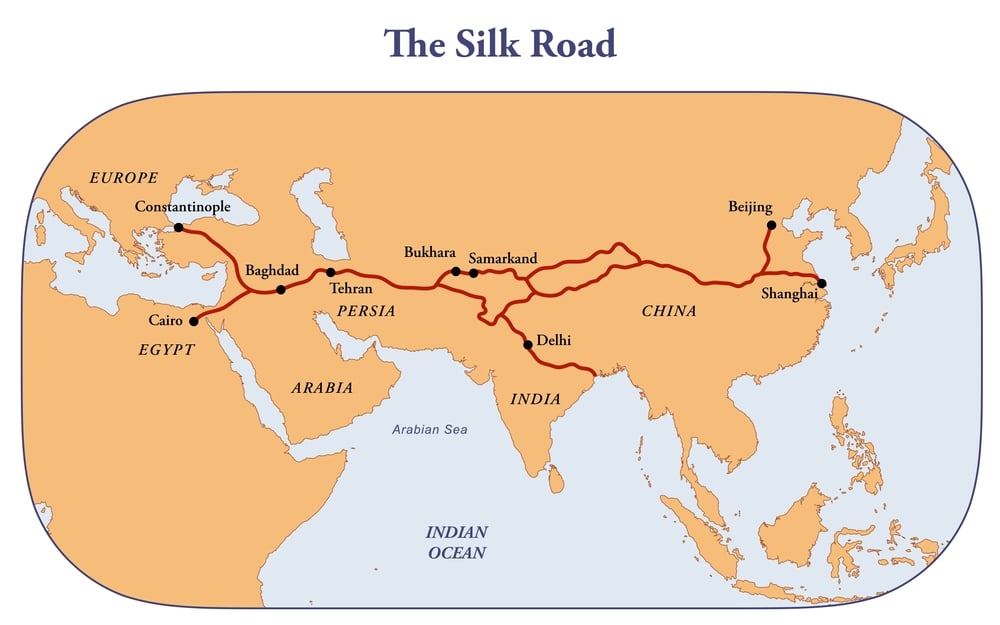
Difference between the old and new Silk Roads: Trade, culture, and exchange in ancient times
The Old Silk Road (or Silk Road network) was not a single, linear route, but a complex network of trade routes connecting China (especially the city of Chang’an, now Xi’an) with Central Asia, Asia Minor, the Middle East, and Europe.
- Main routes and cities: Main route: From Chang’an westward through the Gansu Basin, along the north or south of the Taklamakan Desert, via Kashgar, then through Central Asia (e.g., Samarkand, Bukhara, Kokand) and on via Persia to the Mediterranean.
- Important branches were north of the Tian Shan Mountains, e.g. through southern Kazakhstan and south along the Taklamakan or over the high mountains in Central Asia.
- Important cities: Xi’an (Chang’an) as the starting point in China; Kashgar as an important hub in the Tarim region; Samarkand and Bukhara as cultural and trade centers in Transoxania; Cities such as Merv, Turfan, Dunhuang, etc.
- Trade, technology, and cultural exchange: Trade in goods: Silk from China, spices, precious stones, glassware, cinnamon, religious books, porcelain, etc. in exchange for gold, silver, horses, fabrics, etc.
- Technological and cultural innovations: Paper: Paper production spread from China to Central Asia and further into the Islamic world. Manuscripts and translations were distributed along these routes. Black powder, printing, compass and other technologies were either passed on indirectly or influenced developments along the routes (black powder and the compass originated in China, and their spread was facilitated by these contacts).
- Religions and ideas: Buddhism spread from the Indian subcontinent via Central Asia to China. In addition, Manichaeism, Nestorian Christianity, Zoroastrianism, and later Islam spread along the Silk Road.
The Belt and Road Initiative (New Silk Road): Concept and Routes
The Belt and Road Initiative was launched in 2013 by Chinese President Xi Jinping. Its goal is to develop a global transport, energy, and trade network connecting Asia, Europe, Africa, and parts of Latin America. The Chinese government refers to it as a “win-win cooperation,” but critics see it as a means of expanding Chinese power and influence.
- The initiative comprises several land and sea corridors that together form a widely ramified network: Land routes (Belt): The China-Central Asia-Western Europe Corridor, which runs through Kazakhstan, Russia, and Belarus to Europe, and the China-Pakistan Economic Corridor (CPEC), which connects western China to the Arabian Sea via the port of Gwadar. In addition, there is the China-Indochina Corridor via Laos, Vietnam, and Thailand, and a route via Iran and Turkey towards the Mediterranean.
- Maritime Route (Road): The 21st Century Maritime Silk Road runs along the coasts of Southeast Asia, through the Indian Ocean, across Africa and into the Mediterranean.
- Since the start of the project, investments of more than $1.3 trillion have been pledged worldwide (as of mid-2025). The focus is on the construction of ports, railways, roads, energy facilities, and digital infrastructure.

Opportunities and challenges of the New Silk Road
For China, the initiative means strategic security for trade routes and resources, but also the consolidation of its status as a global economic power. Germany and the EU could benefit from the new routes, for example through faster transport connections, access to new markets, and cooperation in the energy sector. Nevertheless, there are significant points of criticism:
- Debt and dependency: Countries such as Sri Lanka and Kenya have had to cede infrastructure to China or take on long-term debt.
- Lack of transparency: Many contracts remain confidential, which increases mistrust of China’s motives.
- Geopolitical tensions: The US and parts of the EU see the BRI as an attempt to establish an alternative world economic order under Chinese leadership.
- Ecological and social consequences: Some large-scale projects endanger ecosystems and local communities.
- Despite these challenges, the BRI remains a key driver of global infrastructure development, especially in regions where investment has been low to date.
The Old and New Silk Roads in comparison – symbolism and future prospects
The old and new Silk Roads are separated by more than 2,000 years, yet they are linked by the same idea: exchange between East and West. The difference lies primarily in the means, goals, and scope of the exchange.
- The old Silk Road was primarily a network of caravan routes that connected trade, religions, cultures, and technologies. Its goal was not power, but the exchange of goods such as silk, spices, glass, and paper, as well as ideas and beliefs.
- The participants were merchants, pilgrims, scholars, and local rulers who made the exchange possible. It stretched from China through Central Asia to Europe and was of great cultural and economic importance.
- The New Silk Road, on the other hand, is a modern, state-controlled large-scale project that has been implemented by China since 2013 under the name Belt and Road Initiative. The focus is on infrastructure, trade routes, energy projects, and digital networks that are intended to connect Asia, Africa, Europe, and parts of Latin America. The goal is not only economic networking, but also to strengthen China’s geopolitical influence.
- While the old Silk Road was primarily about mutual exchange and cultural enrichment, the new initiative pursues clear economic and strategic interests. It opens up opportunities for countries such as Germany and the EU through faster transport routes, new markets, and energy cooperation. At the same time, there are risks: debt, dependency, lack of transparency, and environmental and social challenges.
- However, both eras of the Silk Road show how closely trade, infrastructure, and cultural exchange are linked. The future of the New Silk Road will depend on whether economic benefits, fair partnerships, and sustainable development are placed at the center—similar to the old Silk Road, which connected East and West for centuries.