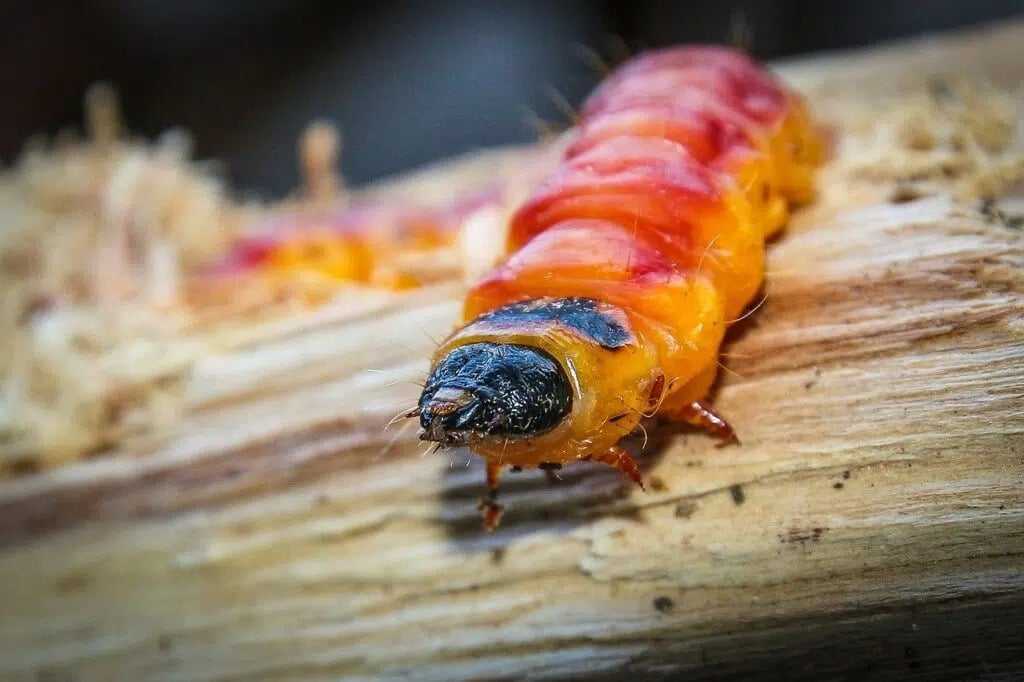
Willow borer caterpillars are unwelcome guests, as they can cause the sudden death of trees and shrubs. We have researched how you can identify these pests and stop them from spreading.
Willow borer: Caterpillars also damage fruit trees
If you hear crackling and crunching in your apple tree at night, it sounds rather eerie. The noises may be caused by a swarm of willow borer caterpillars feeding their way through the fruit tree. This can cause significant damage, potentially leading to the tree dying.
- The moth known as ‘Cossus cossus’, which emerges from the willow borer caterpillars, is harmless. The moth has a wingspan of up to eight centimetres. Its colour and pattern are camouflaged to match tree bark.
- You rarely get to see the moth, as it flies in the evening and at night to find a suitable spot for mating and laying eggs.
- Occasionally, individuals may stray into residential properties. If you spot a moth, take a closer look at your trees.
- You are also unlikely to see the caterpillars. After hatching, they develop under the bark and underground amongst the root system over several years.
- The willow borer caterpillar has a yellow abdomen, a red back and a black head and neck. The larvae have a row of black spines on their abdomen. Larvae are about 5 centimetres long, whilst caterpillars are approximately 10 centimetres long.
Identifying an infestation with Cossus cossus
The pest’s preferred breeding grounds are old, already slightly rotten trees. Willows in particular are popular sites for laying eggs. The caterpillars also readily infest poplars, birches and alders, as well as healthy apple and pear trees.
- If there is a smell of vinegar around a tree, this should be a warning sign for you. The willow borer’s offspring undergo several years of development beneath the bark and within the wood of the trees.
- Only older caterpillars give off a pungent, vinegar-like odour. If you notice this sign, the infestation may already be quite advanced without you having realised it beforehand.
- Right from the start of the caterpillars’ colonisation, reddish wood shavings begin to accumulate on the ground in the immediate vicinity of the tree trunk. You may occasionally spot dark faecal remains in these shavings.
- The caterpillars bore small, oval-shaped holes into the bark of the infested tree. Depending on the caterpillar cohort, numerous oval feeding tunnels, up to one centimetre in diameter, can be found within the wood.
- More and more withered branches and wilted leaves appear on the tree itself. Parts of the tree gradually die off. Overall, the plant is susceptible to fungal infections.
- Trees that are already infested attract females, which then lay hundreds of eggs there as well. This can quickly lead to a mass infestation.

How to control the willow borer
As the willow borer can cause massive damage to your trees, it is important to control it in good time and prevent it from spreading widely.
- From July to September, check your trees regularly, paying particular attention to the lower part of the trunk. If you spot an infestation early on, you stand a good chance of successfully getting rid of these uninvited garden guests.
- However, collecting the caterpillars and using conventional methods to control them is not feasible in the case of the willow borer, as they hide beneath the tree bark.
- There are also no approved chemical pesticides against the caterpillar. Nevertheless, you can tackle the infestation with a homemade ‘chemical’ solution: Make your own quassia and soap solution and apply it several times at intervals of a few weeks.
- To make the quassia and soap solution, soak 150 grams of quassia wood in 2 litres of water for 24 hours. Then simmer the mixture for over an hour and strain it. Add 250 grams of soft soap to the decoction.
- Spray this mixture, diluted to a ratio of 1:5, into the boreholes, onto the lower part of the trunk and onto infested branches. This will form a soapy coating. You can wash this off with water after a few days.
- If you are looking for an environmentally friendly method: parasitic wasps, as natural predators, can also successfully keep willow borers at bay. To do this, however, you will need to introduce a large number of parasitic wasp larvae onto these pests – which can sometimes be expensive.
- Some people also try impaling the caterpillars in their boreholes using a thin wire. If you give this a go, you’ll probably soon realise that this method is time-consuming, laborious and, ultimately, ineffective.
- Unfortunately, for heavily infested trees, the only effective solution is usually to prune back the affected areas rigorously or even remove the tree completely, including the root system. Important: You should not dispose of infested material in the compost.