300
The HCG value provides information about a pregnancy. The body produces beta-HCG just a few days after fertilization. In this family tip, we have summarized for you what values that are too low or too high mean.
HCG levels should be this high during pregnancy
As soon as the fertilized egg has managed to implant in your uterine lining, the body produces the pregnancy-preserving hormone human chorionic gonadotropin, abbreviated as hCG or HCG.
- A week later, when you actually have your period, the hormone is also excreted in the urine. This is why it only makes sense to carry out a pregnancy test with a commercially available product at this point.
- Before then, the hormone can only be determined via a blood test carried out by a doctor.
- The HCG is a pregnancy hormone. Its main function is to maintain the pregnancy. Initially, it is produced by the outer germ cell (part of the fertilized egg). Then the placenta takes over HCG production.
- The hormone increases oestrogen and progesterone levels. As a result, the monthly period is suppressed.
It also has an effect on the lining of the uterus and causes it to grow. Systemically, the hormone causes the typical changes of a pregnant woman. - If you are not pregnant, the HCG value is below 2 IU/l (international units per liter) at childbearing age. Two weeks after fertilization, when you are in the 4th week of pregnancy, the value should have increased to at least 25 IU/l.
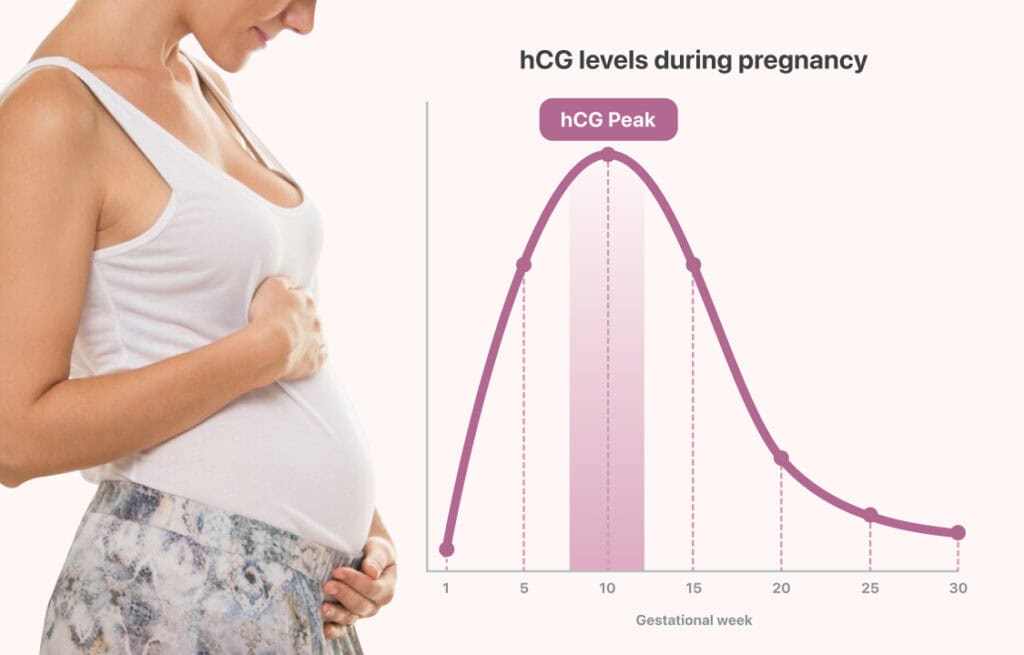
- At first, the HCG level rises very quickly. It doubles every two days, then every 3 or 5 days. It reaches its highest level between the 8th and 12th week of pregnancy. After this, the value drops again and remains at a low level until the baby is born.
- The exact values can be found in the table.

What the HCG values tell us
The values fluctuate greatly within the normal range, which is why an HCG value cannot be used to make a reliable statement about which week of pregnancy you are in.
- If the values are very high, i.e. they are always at the upper end of the normal range, a multiple pregnancy can be assumed.
- However, there is also the possibility that a disease is present, for example a trophoblastic disease.
This is a chromosomal abnormality during pregnancy. Vaginal bleeding usually occurs very quickly. - If the values are very low and do not double in the first few days, the doctor can assume that it is a non-viable pregnancy. Often it is a restrained miscarriage.