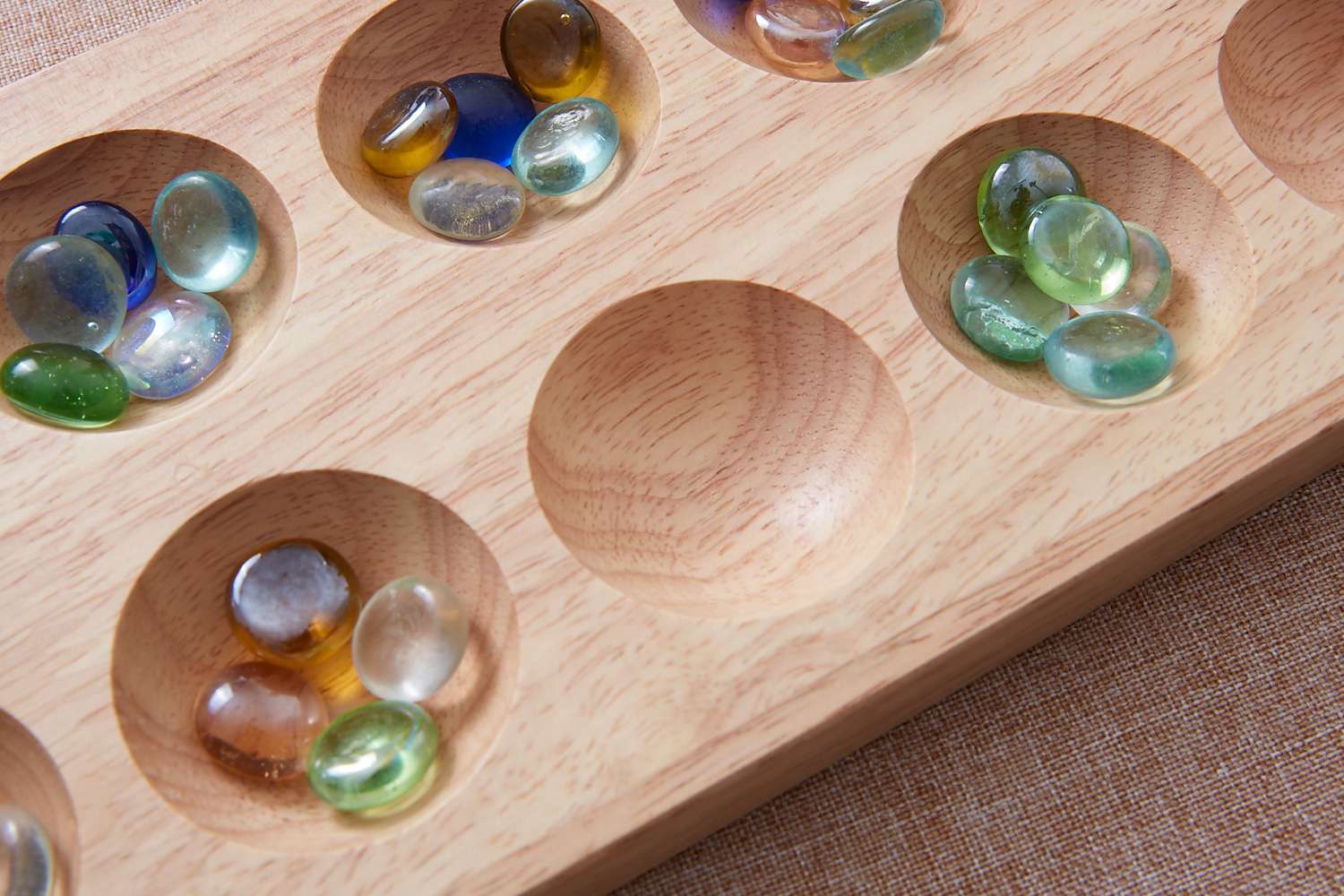
To play Mancala, all you need is two players, a game board, game pieces and the rules. The game is available in many variants, which are, however, quite similar.
Mancala: Naming and game structure according to the rules
The term Mancala refers to board games that are usually played by two people. Typical for the games is a playing board, which is covered with hollows. The game pieces resemble beans, which is why the Mancala game is also called the bean game in Germany and is one of the classics among board games.
- Playing field: The playing field consists of a board with twelve hollows. These are arranged in two rows. There is a large well at each end of the board to collect the tokens. The large hollows are also called mancala.
- Structure: The number of starting tiles used per well can vary depending on the variant. Usually two to six stones are used, with four being the norm according to the tournament rules. These are placed in each of the twelve small wells. The large mancala wells initially remain empty. The players sit opposite each other at the board. Each player owns the six trays in front of them.
- Variations: There are many variations of the Mancala board game. They usually differ in the number of pieces and the rules for “capturing” or “scoring”. You can also introduce special rules.

Mancala rules: A possible variant
Once the playing field has been set up and the players have taken their seats, the game can begin.
The exact mechanics of the game can depend heavily on regional traditions. For example, there are African and Arabic variants. However, the aim of the game is always to collect as many tiles as possible in your own Mancala hollow.
- Start of the game: First, you decide which player starts. You have a free choice. Usually a coin is tossed or a round of rock-paper-scissors is used to decide who starts.
- Playing the game: The player whose turn it is chooses one of their trays and picks up all the tiles in it. These are distributed individually according to the chosen distribution direction (e.g. left/right or clockwise). First to your own and then to your opponent’s.
In some versions, your own Kalaha is taken into account when distributing, in others it is skipped. This gives you a free choice and you can decide on a variant. The mancala hollow is skipped. - Note: Collection trays are sometimes considered active game trays and are included in the turn, while in other versions they are purely passive;
- Capturing: Capturing is also not uniformly regulated and in some rules opposing pieces are only captured when they land in your own empty hollows, in others with an even number of pieces. If you place the last piece and the hollow is already filled with two, four or six pieces, the pieces land in your Mancala hollow. If there are also two, four or six tiles in the hollows in front of the Mancala hollow, these will also end up in your Mancala hollow;
- End of the game: As soon as there are no more tiles on a player’s side, the game is over. The player with the most tiles in the Mancala tray wins. There can also be a draw if the number of stones in the Kalahas is identical. You can use additional rules (e.g. counting stones in remaining trays) to define the final score more precisely.
The game ends abruptly if the opponent moves in all the remaining stones on his side when the opponent’s rows are empty. - Draw: A draw is possible if the number of stones in the Kalahas is equal. However, if you want to clarify the end of the game, additional rules can help. One possibility is to count the stones in the remaining hollows.
- By the way: New moves are not only possible when the last stone lands in your own Kalaha, but in some variants also when certain numbers of stones are hit in hollows. Here too, you are free to decide which rules you want to introduce in your game.