243
Ubongo is a very fast-paced game that requires strong logical thinking. We’ve put together a clear and concise guide to the rules of Ubongo for you. The rules are very simple and easy to understand.
Ubongo Game Instructions: What You Need to Know and How to Set Up
So you and your family can start playing right away, we’ll explain how to set up the game and what the objective is. The rules presented here apply to the older version of Ubongo.
- Ubongo is a family game that can also be played by children as young as eight years old. However, due to the game’s difficulty and fast pace, players shouldn’t be much younger than that.
- The game can be played alone or by up to four people at the same time.
- There are two different difficulty levels, allowing you to challenge yourself again and again.
- The logical thinking is meant to be fostered by the game, which is particularly interesting for younger people and children.
- Objective: The basic goal of the game is to collect as many gems of the same color as possible by strategically placing your tiles.
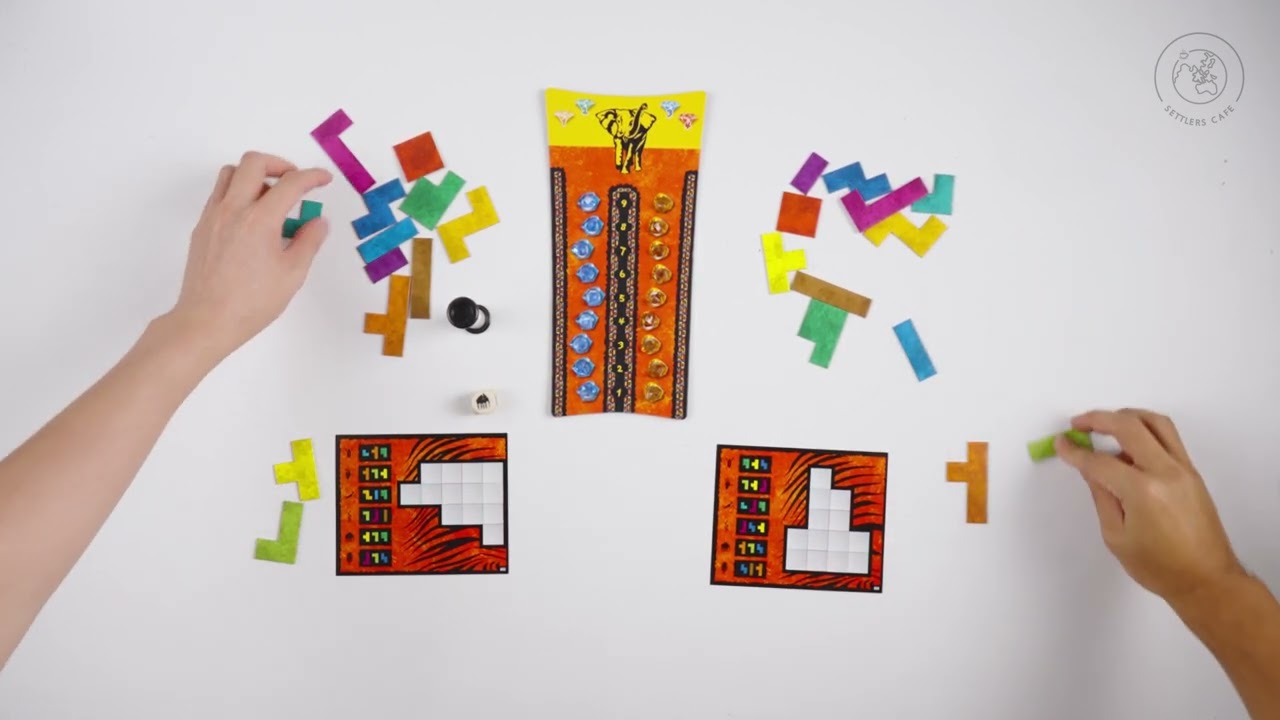
- Setup: Set up the game board and place it in the center of the table. Then distribute the gems randomly into the corresponding holes. Place only one gem per hole.
- Each player now takes a playing piece and places it on one of the six elongated spaces; multiple pieces are allowed on a single space.
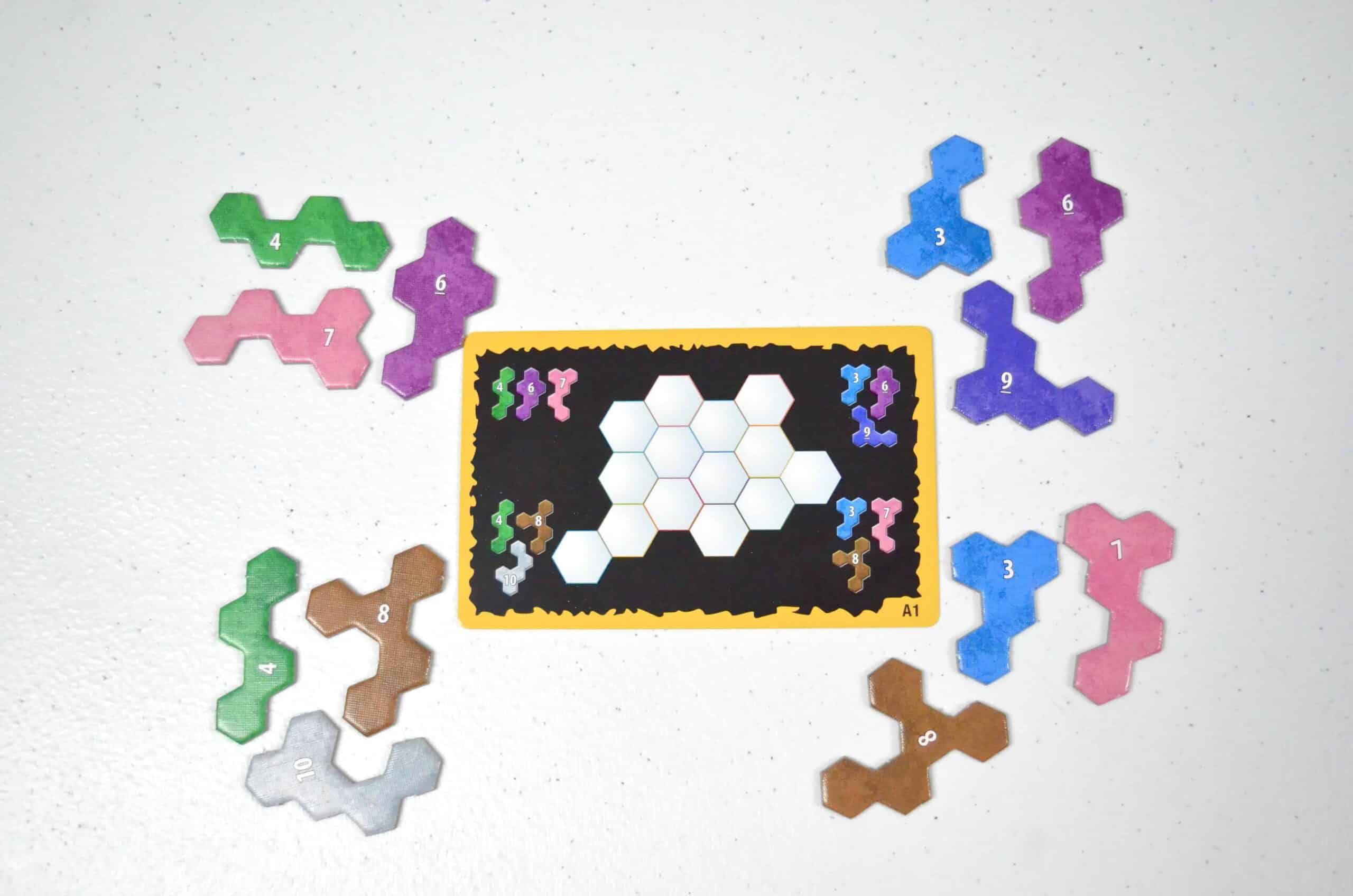
- Next, distribute the 12 colored tiles—which all differ in shape and color—to each player. Players may decide whether they want to play with three or four tiles on their board; more tiles make the game more difficult.
- With two players, set aside 18 game boards; with three players, set aside nine boards. With four players, use all the boards. Shuffle the game boards thoroughly and stack them face down next to the game board.
- New Edition: In the new edition, only the blue and brown gems are placed on the game board.
Ubongo: How to Play
Once you’ve set up the game, all you need are the basic rules to get started right away. We’ve summarized them as clearly as possible:
- First, a starting player is chosen.
- Turn Order: Each player takes one placement board and places it in front of them. Now the player whose turn it is rolls the dice and at the same time, the hourglass is flipped over. The dice determine which pieces may be used—these are shown on the tile board next to the dice symbols.
- Now try to as quickly as possible exactly fill your area with the pieces. The first player to do so calls out “Ubongo” and may move their playing piece up to three spaces on the red spaces or stay put. From the row where the piece is located, they may take the two frontmost gems and place them in front of them—this must happen before time runs out.
- The other players continue playing until the time runs out. The second-fastest player may move their piece up to two spaces or stay put and also take the two gems from their row. A third player may move their piece one space and also take two gems.
- If a fourth player manages to do this within the time limit, they must stay in place but may still take two gems. These must always be the gems closest to the playing piece in the respective row.
- End of the round: When the time has run out, the round ends and the boards are collected. Each player receives a new board, and play continues clockwise.
- End of the game: The game ends after nine rounds. The player with the most gems of a single color wins. In the event of a tie, the player with the second-most gems of that color wins.
- Example calculation: Player A has six red, four blue, and two green gems. Player B has four red, three blue, and six green gems. Since both players have six gems of one color each, the tiebreaker is the second-highest number of gems of that color. Both players also have four gems of the same color each. Therefore, Player B wins because he has three blue gems and Player A has only two green gems.
- Difference from the new Ubongo: In the new version, the distribution of gems is different. The first player receives a blue gem and the second a brown one. Additionally, each successful player receives a gem from a bag.
- In the new edition, each gem also has a point value. Red gems are worth four points, blue gems three points, green gems two points, and brown gems one point. The player who has collected the most valuable gems at the end wins.
Special Rules for Ubongo
In addition to the general game rules, there are a few special rules that only apply in certain situations.
- If no player manages to fill the area within the time limit, the hourglass is flipped over again. If there is still no winner, the tiles are set aside and new ones are dealt.
- With fewer than four players, the movement rules remain the same.
- The gems must always be laid out visibly in front of the players.
- Once a row has been completely emptied, you can no longer collect any more gems from it—select another row.
- If a player does not collect their gems before time runs out, they receive none for that round. Likewise, players who were unable to fill their board correctly within the time limit receive no gems.