3
The Charivari is a piece of Bavarian traditional costume jewellery that is attached to dirndls and Lederhosen. In this article, you’ll find out more about it.
The Charivari as part of the traditional costume
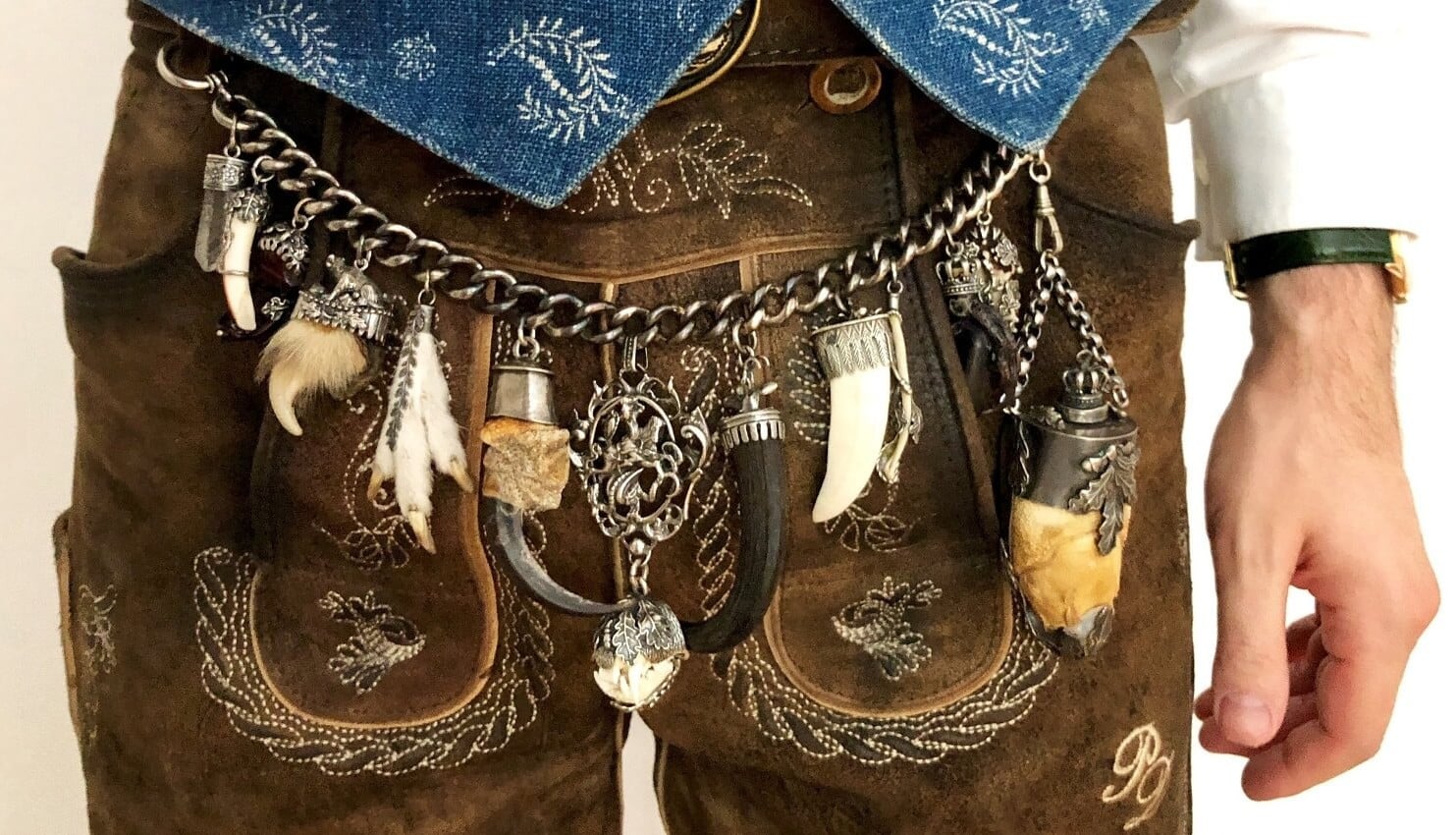
- For men, it is usually a silver chain with various pendants. It is worn as a decorative chain on the fly of the Lederhosen.
- A wide variety of pendants are attached to the chain. These can include coins, animal teeth or other items. Those who adhere to tradition do not buy these pendants; they earn them, for example whilst hunting.
- Women also wear Charivaris. Normally, these chains are fastened to the bodice below the neckline. However, some women now also wear the Charivari on their dirndl apron.
- Talismans can also be attached to the women’s version. However, silver pendants featuring nature motifs or hearts are more common here.
- There are also women’s charivaris without talismans; these are crafted like a jewellery necklace.
- In those parts of Bavaria where traditional dress is particularly highly valued, girls and boys are often given their Charivari as a gift at their Confirmation. This allows them to add to the necklace over the course of their lives.
- It is also customary to pass a Charivari down through the family.

Charivari – a history steeped in tradition
The Charivari is an integral part of Bavarian traditional dress and has a long history. Here are a few things you may not have known about Charivaris:
- The name ‘Charivari’ comes from French and means ‘to make a noise’. Originally, it was a custom in which villagers used noise and music to drive unwelcome people out of the village. Later, the custom was adopted for weddings, where the bride and groom were greeted with noise and commotion. Over time, the charivari was repurposed as a piece of jewellery.
- In the past, charivaris were not only jewellery but also served a protective function. The pendants were intended to ward off evil spirits and protect the wearer from misfortune. The coins, which often hung from the chains, were also meant to fill the wearer’s purse.
- The pendants on charivaris were often personal items that told a story. For example, the pendants could reveal whether the wearer was a hunter, a fisherman or a blacksmith.
- Charivaris were often passed down from generation to generation and expanded upon. As such, one could trace the family history through the charivari.
- Today, there are also modern charivaris that differ from the traditional chains. For example, there are charivaris made of stainless steel or with plastic pendants.
- In some regions, there are specific rules on how the charivari should be worn. For example, one should ensure that the pendants do not make too much noise or that one does not wear too many of them. The charivari is therefore not just a piece of jewellery, but also has a deeper meaning. It is a symbol of tradition and history and will remain an important part of Bavarian traditional dress in the future.