The rules of Kniffel may seem complex at first. However, the popular dice game is easy to learn.
Rules for Kniffel: How the dice game works
A minimum of two players are required for Kniffel. You can play it well as a party game for two. Theoretically, there is no upper limit to the number of players. A maximum of eight is usual.
- The aim of the dice game is to collect as many points as possible by skillfully rolling the dice and selecting the squares on the game block. In a total of 13 rounds, you try to achieve certain combinations of dice. The players roll the dice up to three times per round, starting with 5 dice.
- You decide which of the squares on the game block is most likely to be reached and score the most points based on the number of dice rolled. Put the matching dice to one side. Put the remaining dice back in the cup and roll them again.
- You can also roll all the dice again if there are no matching numbers. You must always enter something in the dice block. Even if you have no luck with the dice and cannot enter anything in any field, you must enter 0 points in a field of your choice.
- The game is over when each person has filled in the fields on their card.
As with other dice games, the points are added up at the end. - There is an upper and lower area on the block. If you have scored at least 65 points in the upper section, you receive 35 extra points. The points from the lower area are added to this. The round is won by the player who scores the most points in total.
Preparation for puzzles: How to get started right away
Each person playing gets a score sheet from the puzzle block on which they can enter their respective points.
- There are several columns on the score sheet, each representing a round of Yahtzee.
- The dice combinations to be achieved in Kniffel are shown with a predetermined number of points on the Kniffel block or must be added together using the number of dice rolled.
- The game can begin after the name of each player has been written on the top line of their hand.
- To determine who starts, the dice are rolled in turn. Whoever has the highest number gets to start the game and pick up the cup with the dice. In some families, there is also a rule that the youngest person gets to start.
- You can play Yahtzee on a cozy afternoon or evening at home or with large foam dice as Yahtzee for the garden.

Kniffel combinations: How to collect as many points as possible
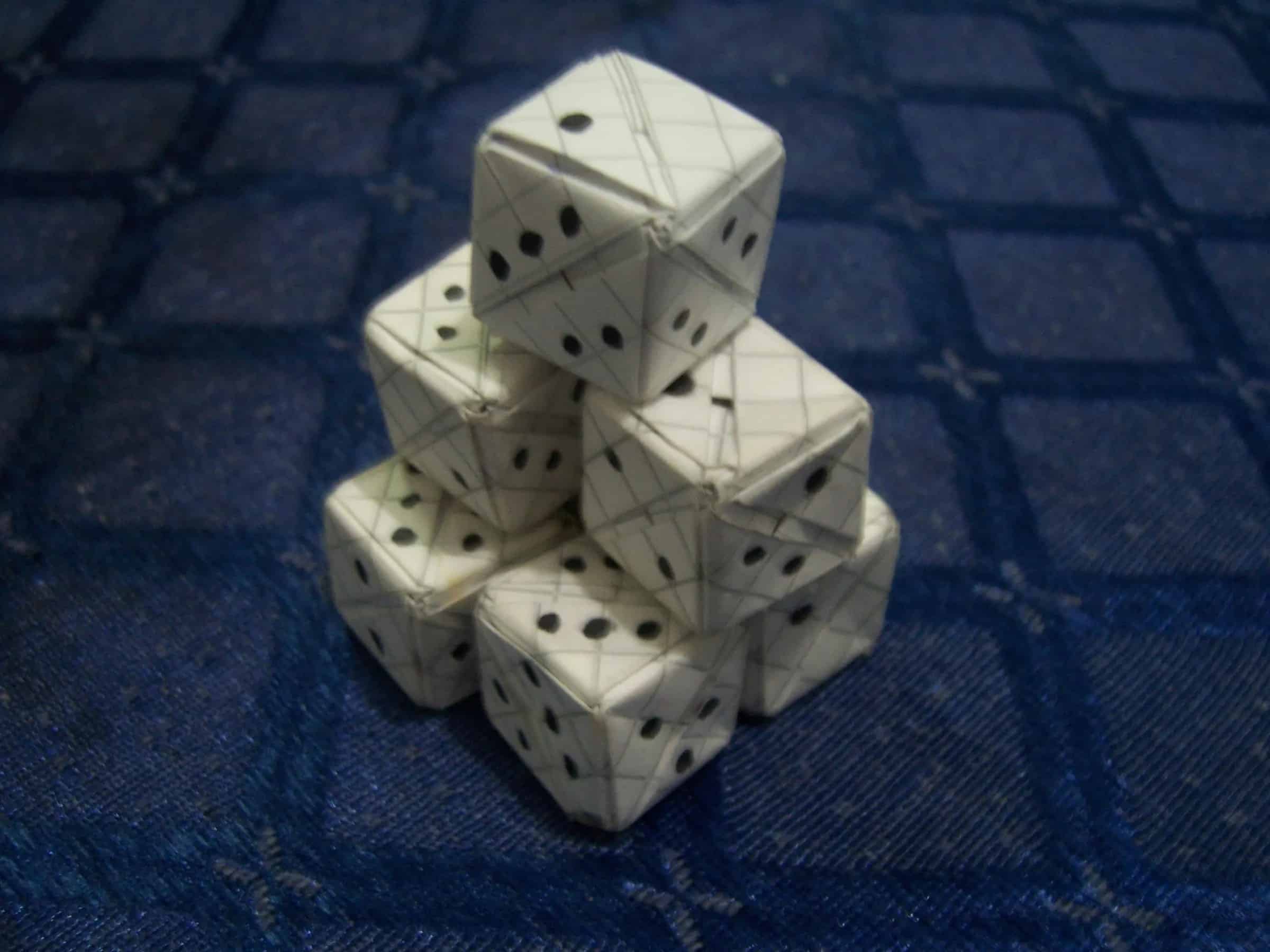
Kniffel is a popular dice game that is also available as Kniffel for children . If you want to do something crafty with your children, you can make the dice together in advance for the game. In Yahtzee, cleverly combining the numbers on the dice scores as many points as possible. To be successful at Yahtzee, you need to assess the potential of different dice combinations.
- Dice numbers in the upper area: For the fields of 1s to 6s, for example, the sum of all the deuces rolled is entered for the 2s. For example, if you have rolled 4 deuces, enter the total of 8 (4 x 2) in the field for the 2s.
- Trees or fours: For these combinations, you need the same number at least three or four times. The points of the same numbers are added together. With 3 deuces, this results in a 6 for a triple. With 4 deuces, you get an 8 for a four-of-a-kind.
- Full house: In full house, the combinations of 2 and 3 identical numbers are counted. For example, you can roll 3 deuces and 2 ones. Regardless of the actual number of points, 25 points are always entered in the field.
- Small street/Large street: For the small street, you need 4 consecutive numbers, for example 1, 2, 3, 4 (or 2-5 or 3-6). You get 30 points for this.
For the big street you need 5 consecutive numbers for 40 points, i.e. 1-5 or 2-6. - Kniffel: DerKniffelis the combination with the highest number of points. You need to roll the same number five times for 50 points. If you roll more than one dice in a round, 50 extra points are noted on the back of the sheet for each additional dice.
- Chance: With Chance nothing has to match. Here you add up all the numbers, so they should be as high as possible. It is a good idea to save the chance. This way, you don’t need to enter 0 points in the game block if you are unable to roll any of the other squares.