1. Glasses are among the inventions of the Middle Ages
Vision problems are a major issue for people. As eyesight deteriorates, it becomes increasingly difficult to navigate the world. Glasses therefore make life easier for people with poor eyesight. The oldest depiction of glasses dates back to 1352 and thus to the Middle Ages. The invention is likely attributed to monks who read and wrote books and often suffered from nearsightedness.
2. The collar is still used today for draft animals
Horses and oxen have been used by humans as draft animals for a very long time. However, especially when carrying heavy loads, leather straps or ropes chafed the animals’ skin and flesh, often leaving them barely able to work due to the pain. The yoke, a padded harness, provided a solution. This device distributes the weight across the shoulders and neck, allowing draft animals to move even heavy loads without pain. The yoke was invented around the year 1000. Yokes are still used today, for example, for carriage horses and logging horses.
3. The spinning wheel enables the rapid production of thread
Thread can be made from wool and plant fibers, which can then be woven into garments. This knowledge was not new even in the Middle Ages. However, what previously had to be laboriously spun by hand could be done much more quickly starting around 1200 with the help of the spinning wheel. Although hand-spun threads were considered to be of higher quality, the spinning wheel made it possible to produce mass-produced goods quickly and easily. Spinning wheels are still in use today.
4. The compass already pointed the way in the Middle Ages
The compass is a very valuable navigation system that indicates the cardinal directions to its user. The reason for this is that the magnetic needle always points north. The first known compass is mentioned in 1269. It consisted of a metal needle attached to a pin. In later models, the cardinal directions were painted on in the form of the familiar compass rose, and the compass was also given a case. Its basic function has remained unchanged to this day.
5. Black powder was invented more by accident
When the monk Berthold Schwarz mixed saltpeter, charcoal, and sulfur together in a mortar in 1315, he had no idea what potential lay behind this mixture. But when a spark fell into the mortar, black powder revealed its explosive power. Inspired by this, Berthold Schwarz conducted many experiments with his newly discovered knowledge, and the powder was soon put to military use. However, it can also be used for peaceful purposes, such as in fireworks. In this form, most of us have probably already used black powder.
6. The printing press makes it easy to produce books
For a very long time, people have been recording thoughts, stories, and events in writing. Especially in the form of books, this was a very laborious undertaking, as every single word had to be written down by hand. Reproduction was correspondingly labor-intensive, and books were generally unaffordable for most people. This changed thanks to Johannes Gutenberg, who in 1450 invented a device that allowed metal letters to be inked and then printed onto paper. This made it possible to produce books in large quantities relatively easily and quickly.
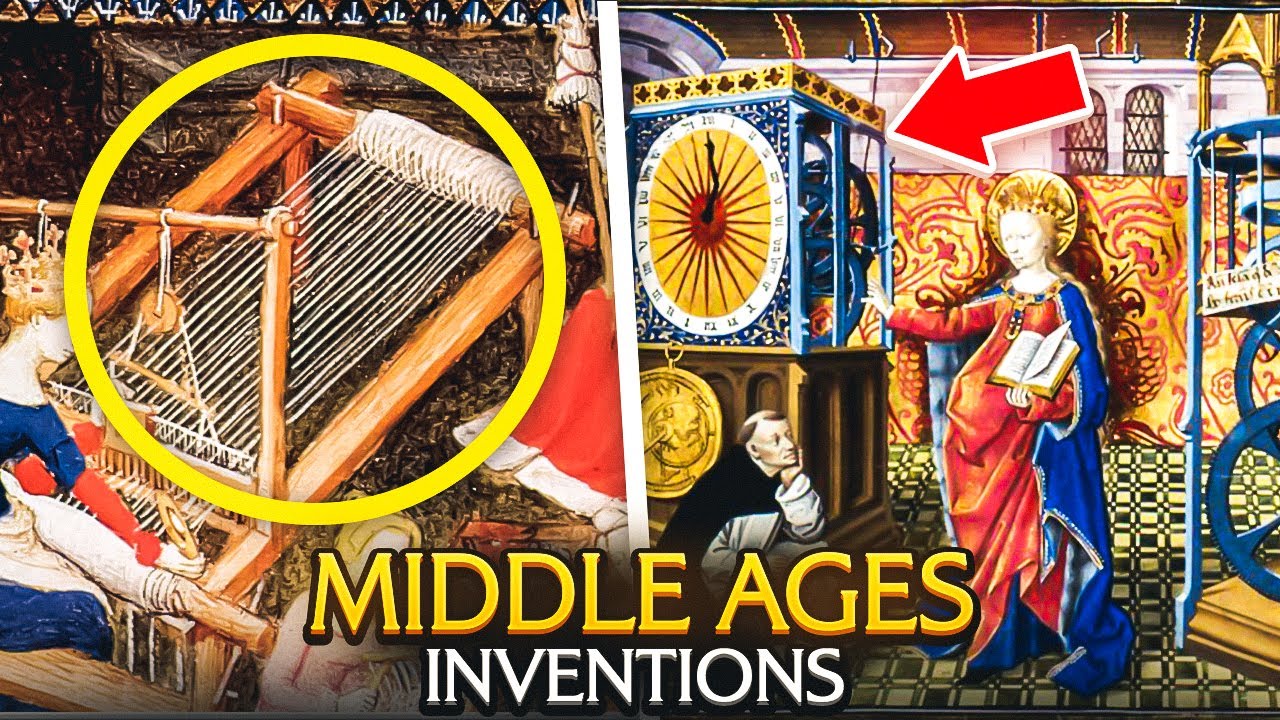
7. Around 1300, thanks to the wheel clock, people knew what hour it was
For a long time, people relied on the position of the sun to tell the time. That changed around the year 1300. That was when the so-called wheel clock was invented. The clock gets its name from the mechanical gears inside it, which ensure that the hands move along with them. Since these clocks were very complex and expensive, however, they were not found in private households, but primarily on church towers and town halls. To this day, mechanical clocks still operate on this principle.
8. The treadle loom facilitates the production of textiles
Looms existed long before the Middle Ages. People in ancient times already knew how to weave threads together and make clothing from them. What was new, however, was the invention of the treadle loom in the 12th century. Thanks to this technical achievement, it became much easier to insert the weft thread. Furthermore, only one person was needed to operate the loom. This allowed textiles to be produced much faster and, consequently, more affordably.