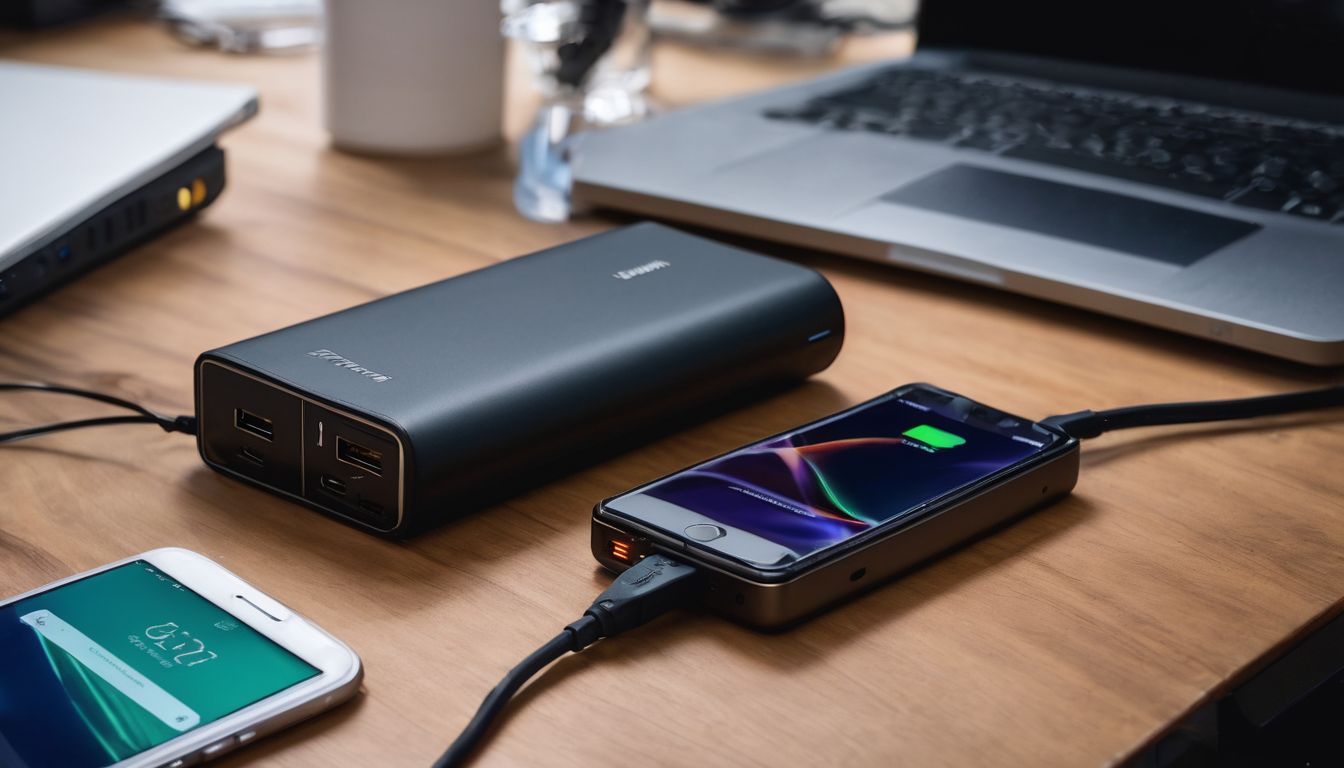
How does a power bank—that small, portable device for storing electrical energy—work? The best way to think of it is as a mobile outlet.
How Does a Power Bank Work? Functionality, Design, Components, and Performance
A power bank is a portable charger with a sturdy and often compact casing that protects the internal components and makes the power bank portable. It is used to power electronic devices such as smartphones, tablets, laptops, smartwatches, and other devices with a USB port while on the go. The power bank serves as an external battery that stores electrical energy and can deliver it to other devices as needed.
- The power bank offers a convenient way to charge devices while traveling, during outdoor activities, or in emergencies. It serves as a reliable backup power source when there’s no outlet nearby. To make this work, it must first be charged using an external power source. LEDs indicate the power bank’s charge level.
- The charge controller ensures that current flows evenly and safely into the cells. The electricity is stored in the internal cells. Most power banks use lithium-ion (Li-Ion) or lithium-polymer (Li-Po) batteries. These have high energy density and efficiency. Li-Ion batteries are cylindrical or prismatic, while Li-Po batteries can be manufactured in more flexible shapes.
- Charge and discharge controllers are circuits that regulate the flow of current to prevent damage to the batteries during charging and discharging. Integrated protection circuits prevent overcharging, deep discharge, short circuits, and overheating. The charge controller and discharge controller share the work as follows: The charge controller regulates the current flow when the power bank is being charged, while the discharge controller ensures a constant and safe charge for external devices.
- The power bank itself is usually charged via a Micro-USB, USB-C, or Lightning port. An external device, such as a smartphone, is connected to the power bank via a USB cable. Most power banks have USB-A or USB-C ports. The connected device is charged by converting the stored energy from the power bank into electrical energy and transferring it to the device.
- A power bank’s capacity is measured in milliampere-hours (mAh) and determines how much energy it can store. A higher capacity means the power bank can store more energy and thus charge more devices or larger ones. However, not all of the stored energy can be used, as some is lost due to heat and circuit efficiency. Efficiency typically ranges between 80 and 90%.
- The time required to fully charge the power bank depends on the power bank’s capacity and the power source’s output. Higher-output power sources charge faster than lower-output ones. In addition, modern power banks are equipped with several protective mechanisms. For example, overcharge protection prevents the battery cells from being charged beyond their maximum capacity.
- Deep-discharge protection prevents the battery cells from dropping below a critical voltage, while short-circuit protection prevents damage caused by short circuits, and temperature protection prevents the battery cells from overheating during the charging process.

Which Model for Which Purpose
There are various models of power banks that differ in several aspects. These include capacity, output power, ports, charging speed, and additional features. The wide variety of power banks is tailored to different needs and applications. Choosing the right power bank depends on your individual requirements.
- If capacity is the most important factor, the first step is to determine the desired electrical current. Keychain power banks, for example, have a low capacity of up to 5,000 mAh and are therefore suitable for emergencies, such as charging a smartphone once.
- Most users opt for standard power banks with capacities ranging from 5,000 mAh to 10,000 mAh. These offer a good balance between portability and performance. They can charge a smartphone once or twice, or a tablet once.
- If you’re looking for a power bank for (multi-day) outdoor activities, it’s best to opt for capacities ranging from 10,000 mAh to 20,000 mAh and above. These power banks are larger and heavier, but they can charge multiple devices several times, including tablets and laptops.
- Another factor to consider when purchasing a power bank is the output power. Basic models already meet simple charging needs, such as charging a smartphone or a watch. However, if you need to constantly charge modern smartphones and tablets, you’re better off choosing fast-charging technologies like Qualcomm Quick Charge or USB Power Delivery.
- As for ports, USB-A is sufficient for using standard power banks. USB-C ports often support fast-charging features. This port is ideal for newer devices with USB-C connectors. Older or budget-friendly power banks feature a Micro-USB port. However, this standard is becoming less common in new models. Apple users often find that many models use Lightning as an input or output.
- Sometimes size is the deciding factor. If you want your power bank to fit in a jacket pocket, go for an ultra-compact keychain model. Models that fit easily in a handbag or briefcase are ideal for everyday use. For longer trips, you’ll need a large-format power bank. While they’re bigger and heavier, they offer much more power and additional features.
- Solar power banks have built-in solar panels. They can be charged by sunlight and are therefore excellent for campers or hikers. If you don’t want to deal with cables, opt for a power bank with Qi wireless charging or one with built-in cables. Large power banks usually offer multiple outputs so that a smartphone and tablet can be charged at the same time.
- Generally, power banks can be categorized into the following types: standard power banks, which are used for smartphones and tablets; fast-charging power banks, which charge devices quickly; solar power banks with built-in solar panels that allow charging via sunlight; and laptop power banks with higher capacity and special connectors.