135
Using a multimeter isn’t difficult, but there are a few things you should keep in mind. An incorrect setting can damage the device. In this article, you’ll learn how to use a universal multimeter.
Using a Multimeter: What You Need to Know
You can use a multimeter to measure voltage, resistance, and current. To prevent damage to the device, there are a few things you should keep in mind.
- If you have no prior experience with these measurements, you should proceed cautiously. A multimeter can quickly become overloaded.
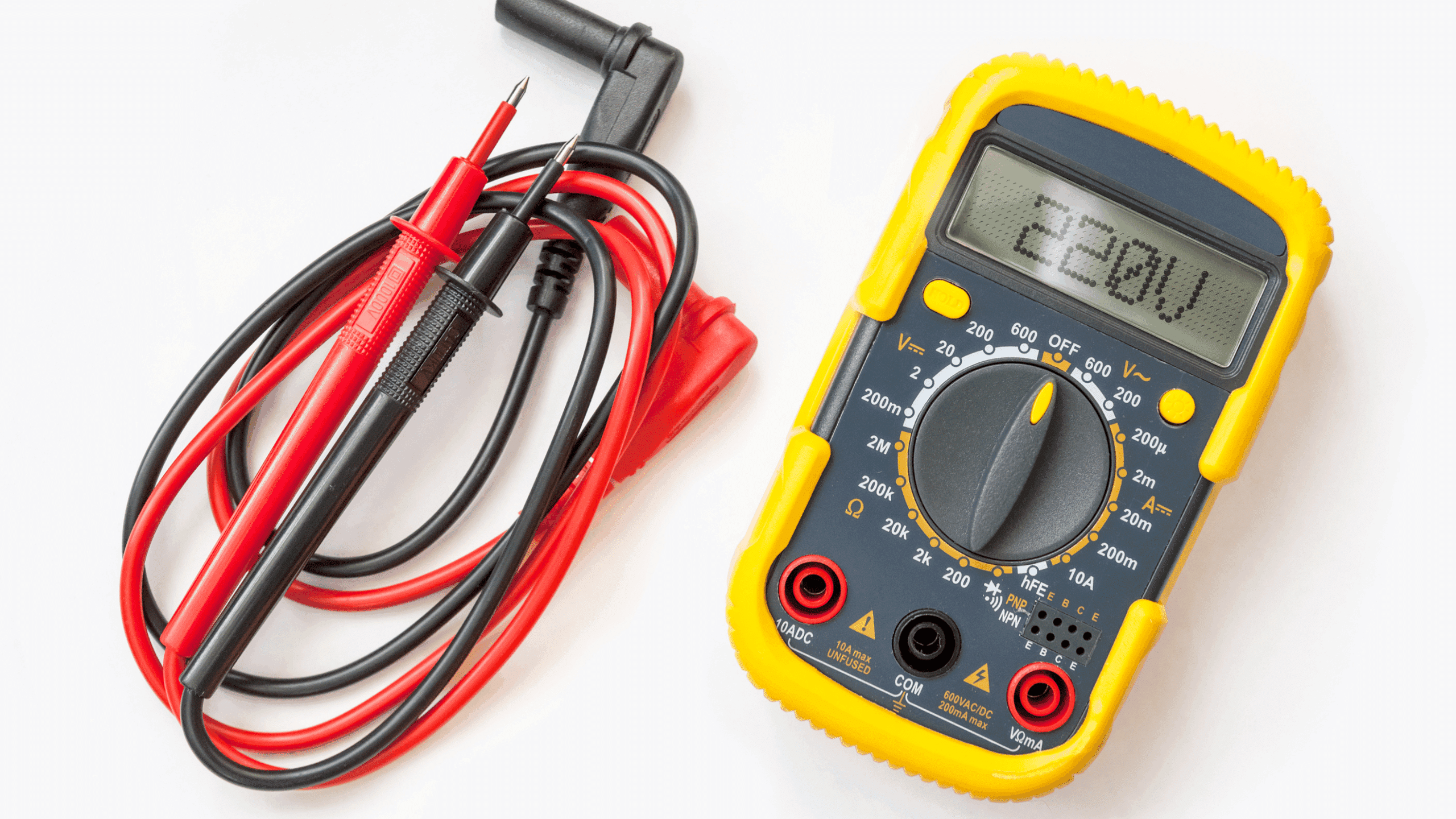
- Today’s multimeters are mostly available as digital models. They feature a display where you can read the values.
- Depending on what you want to measure, you’ll need to proceed differently. Voltage is measured differently than current. If you want to measure the voltage of a battery, simply hold the test probes against the terminals.
- When measuring current, however, you need a closed circuit.
- Furthermore, with affordable multimeters, you can also measure resistance, capacitance, and diodes. In the higher price range, it’s even possible to measure frequencies.
Using the Multimeter Correctly
The basic design of a multimeter is always the same. You have the main unit and two test leads, which are equipped with probes or so-called alligator clips.
- First, turn on the multimeter. To do this, turn the rotary switch to the required measurement range. Of course, there are also devices with a separate on/off switch.
- Measuring voltage is the simplest task. Even though measuring a battery voltage isn’t particularly meaningful, it serves as an example here. First, turn on the device and set it to the required range.
- Once you’ve set it, touch the red test lead to the positive terminal and the black test lead to the negative terminal. Now all you have to do is read the value.
- You might think you can measure electrical outlets this way as well. But that’s far from the truth. To measure them, you must set the multimeter to AC. Therefore, be sure to prioritize your safety.
- If you have the multimeter set to direct current (DC) and use it to measure an outlet, it will display only a low value or 0 V. Nevertheless, current can still flow here. Circuits carrying more than 33 V AC or 70 V DC should generally only be measured by appropriately trained professionals.
- Measuring current is somewhat more complex. To do this, you must connect the multimeter into a circuit. As a starting point, consider a simple circuit consisting of a battery, wires, and a small light bulb.
- To measure the current, you must first open the circuit so you can connect the multimeter in between. It’s helpful if alligator clips are included with the device. To measure the current, attach one wire to each alligator clip and select the amperes setting.
- When you turn on the power, you may get a negative value. This indicates that you need to switch the wires.

Other Uses for the Multimeter
But you can measure more than just current and voltage with it. Sometimes you also need to check resistances to find a faulty spot.
- To measure a resistor , you do not need an additional current or voltage source. The multimeter’s battery serves as the source here. When you set the multimeter to the resistance measurement mode, a small DC voltage is generated at the test probes.
- When you touch the test probes to the resistor, a small test current flows. Based on the magnitude of the current, the multimeter calculates the resistance value and displays it.
- You can also measure capacitors . The measurement is performed exactly the same way as for resistance. Both test leads are connected to the capacitor. However, if you want to measure capacitance, you must apply an AC voltage. The current that flows depends on the capacitance of the capacitor.
- You can also test LEDs. A voltage is applied to the test probes. If the diode blocks this voltage, no current flows, and no voltage is displayed. If the voltage at the test probes is polarized in such a way that the diode allows current to flow, a value will appear on the display.
- When testing diodes, the values obtained can vary widely. For standard diodes, the forward voltage is about 0.6–0.7 V. For Schottky diodes, however, the value is only 0.4 V. The forward voltage depends on the type and color. Values between 1.6 V and 3.7 V are not uncommon.