188
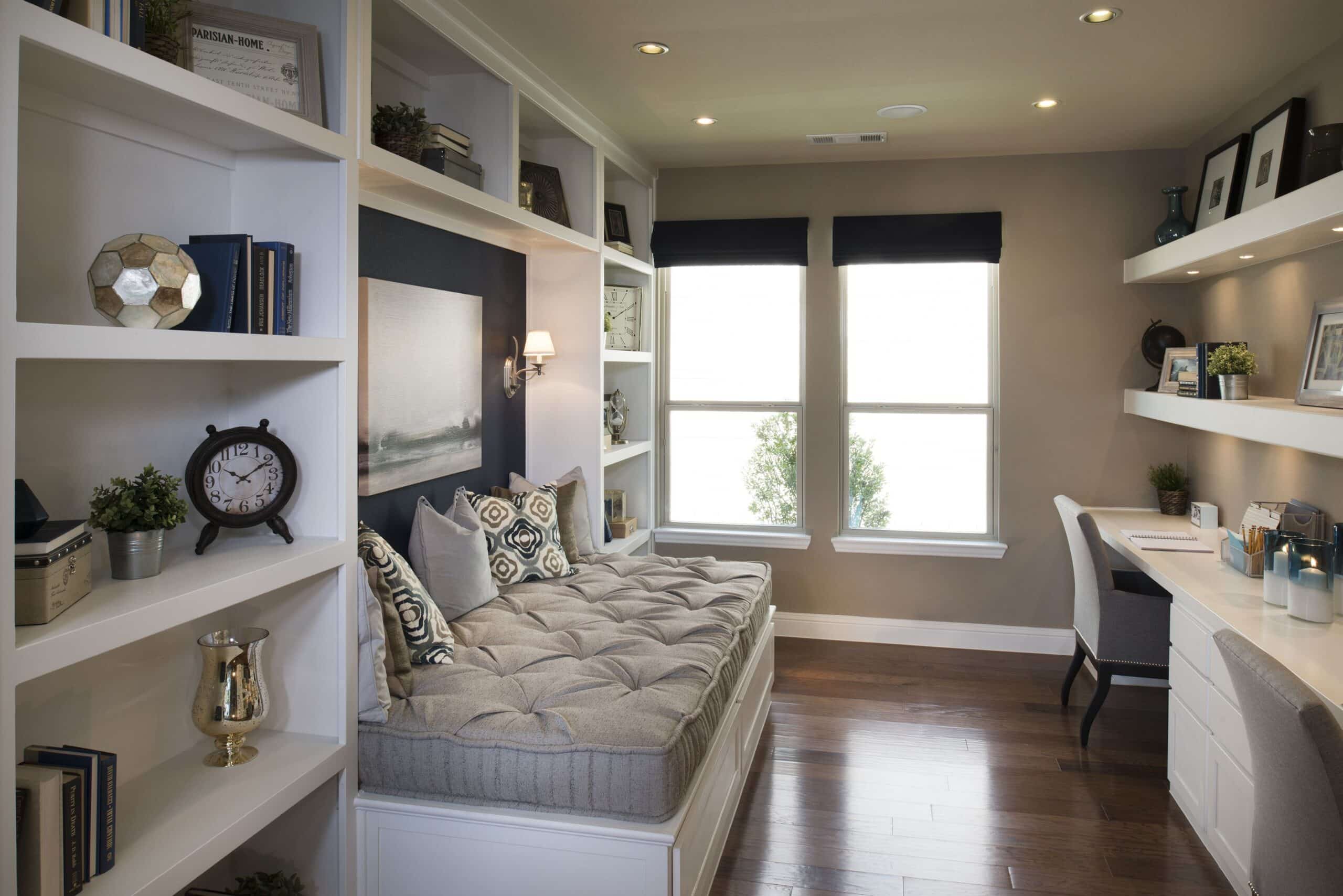
Due to limited space, many people decide to combine their guest room with their home office. In this article, you’ll find tips and tricks on how to best set this up, as well as information on the legal requirements.
Combining a Home Office and a Guest Room
Many employees or self-employed individuals who work from home would like to claim their home office as a tax deduction. However, this isn’t necessarily possible.
- According to the most recent ruling by the Federal Fiscal Court, the decisive factor is that the room is used almost exclusively for work.
- “Almost exclusively” in this context means that it is by no means objectionable if you occasionally write a personal email while you are in your actual home office.
- However, if you like to play video games there in the evening or spend a large portion of your time during the day in the home office browsing the internet for personal purposes, the room is no longer used exclusively for work.
- A rough guideline is that the room may be used for personal purposes by no more than 10%.
- A method in which you use a logbook to document how much time you spend on what in your home office is not accepted here, nor is a physical division of the room.
- So if you regularly entertain guests in your guest room, it is no longer tax-deductible.
- As soon as you place a piece of furniture in the room that suggests another use—such as a bed—you can expect the tax office not to accept it as a pure home office. Sofas, on the other hand, are permitted.
- The status of a sleeper sofa remains controversial. You should have your specific case reviewed in advance by a knowledgeable tax advisor; otherwise, it could end up costing you dearly later on.
- Since you must also meet other requirements that determine the amount you can claim for the home office for tax purposes, consulting with a specialist is essential in any case.
- These include rules regarding the size of your home and the question of your primary place of work.
Furnishings
If you meet the requirements for a tax-deductible home office, you should also make sure you have the right furnishings.
- Generally speaking, any items necessary for your work are permitted: a desk, a bookshelf, a desk chair.
- Items for personal use, such as a crib, a piano (unless, of course, you’re a pianist), or a bookshelf filled with personal books, do not belong in the home office.
- A seating area is permitted if you use it to receive clients or business partners, or to read work-related documents.
- Under these circumstances, a fold-out bed is also permitted.
- If you ensure that the room is used exclusively for work throughout the year, but once a year your brother sleeps on the fold-out bed—which is otherwise used for work more than 90% of the time—for a weekend, there should be no obstacle to claiming the tax deduction.
- However, since these are assessed on a case-by-case basis, you should always consult a tax advisor in advance.

Guest Room in the Home Office
If you do not meet the requirements for a tax deduction for your home office, there are of course no limits on how you use it.
- In this case, you can confidently combine the home office and guest room.
- Here, too, we recommend starting with a stylish sofa bed. You can use this for work to go over important documents or meet with clients.
- It also saves space when it’s not needed as a bed. But when a guest comes to visit, you can simply fold it out.
- Aesthetic room dividers are an excellent way to clearly separate the different areas. That way, you won’t be tempted to lie down for a nap while working in your home office.
- You can also use a shelf to create a separation from your workspace for your guests. Plus, a shelf helps keep things tidy, so your guests feel comfortable.
- You should also make sure things are reasonably tidy. Use organizers, folders, and storage chests to clear away the clutter before your guests arrive.
- And don’t forget the usual items needed in a guest room, such as a bedside lamp that provides pleasant lighting.