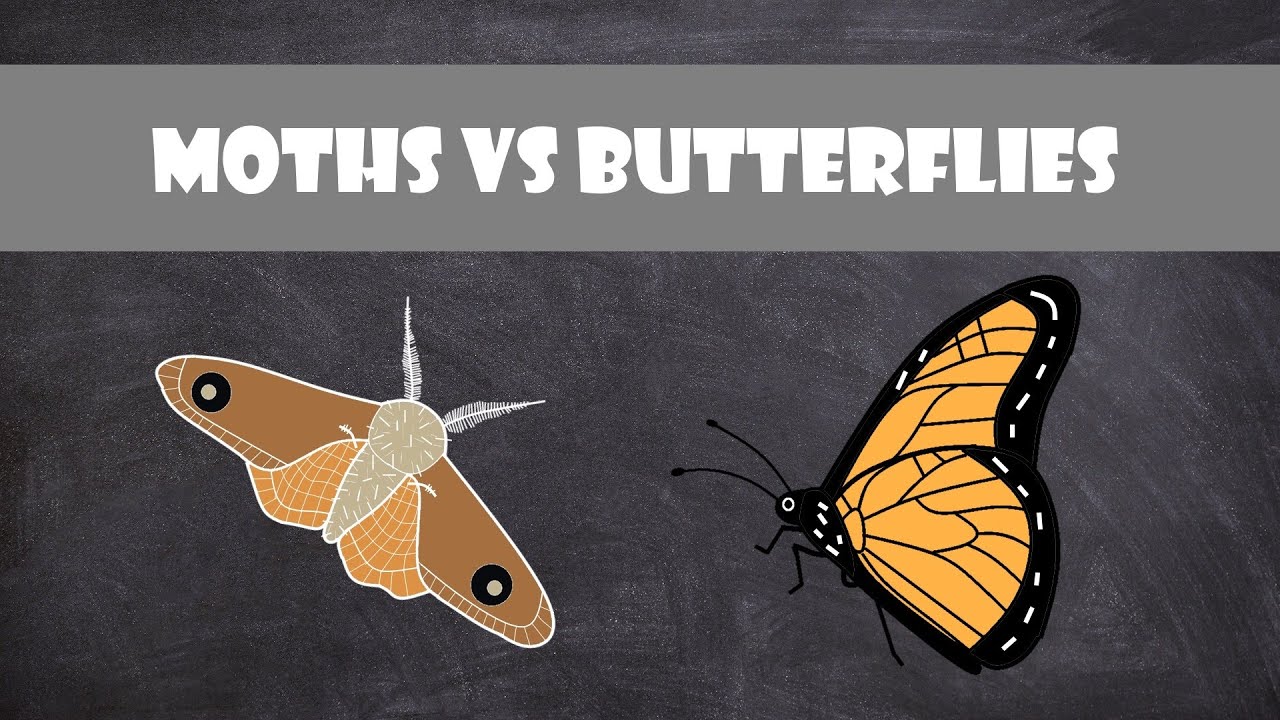
Strictly speaking, there is no difference between moths and butterflies. Zoologically speaking, they all belong to the order of butterflies. Nevertheless, there are some typical characteristics that make it easier to classify them.
Differences between the butterfly and moth families
Colloquially, the distinction is quite clear: all colorful butterflies with pretty wing patterns that flutter around the garden during the day are butterflies. All moths in shades of brown and gray that are out and about in the evening are moths. But it’s not quite that simple.
- There are about 130 families within the order of butterflies. Only a few of these families are scientifically named as moths. All the others are butterflies that are active during the day or at dusk and dawn.
- The exact classification of a butterfly into a group is complicated. Many distinguishing features are not visible to the naked eye of a layman. Even scientists do not always agree and are constantly conducting further research.
- The size of a butterfly can provide an initial clue. Butterflies that belong to one of the moth families tend to be small and are therefore classified as micro-moths.
- The position of the wings when at rest is particularly revealing. If the butterfly folds its wings upwards when resting on a leaf, it probably belongs to one of the butterfly families. If the wings are spread flat or folded over each other like roof tiles, it belongs to a different family.
- In terms of body structure, a distinction can be made between slender butterflies and those with a thick abdomen. A lack of or conspicuous hair is also often easily recognizable.
- The antennae of most butterfly families are narrow and club-shaped at the ends. Animals that mainly fly in the dark often have antennae that look like a comb.

Well-known butterfly families in the human environment
Whether a butterfly appears during the day or rather at dusk is the most noticeable difference between butterfly families for us humans. We encounter these families most frequently outdoors:
- Swallowtails are the classic, diurnal butterflies. The most popular of our garden butterflies belong to this family: peacock butterflies, painted lady butterflies, red admirals, and small tortoiseshells.
- Whites such as brimstone butterflies and cabbage whites are active during the day.
- Blues include many species of rather small, diurnal butterflies, which, despite their name, can also be colors other than blue.
- Hawk moths look like beetles at first glance with their narrow bodies and folded wings. Most species are diurnal.
- Hawk moths fly both during the day and in the evening. They have a broad abdomen and often distinctive wing markings. The hummingbird hawk moth, which buzzes like a hummingbird, belongs to this group.
- Geometer moths, spinners, and owl moths are the most common families of large and small “moths” that flutter around lamps in the evening or sometimes stray into the house.
What exactly are moths?
Few butterfly families are called “moths.” Most of these animals are only a few millimeters in size, and we never see them or only see their traces.
- Web moths weave dense webs around their food plants, such as the spindle tree web moth.
- The family of true moths also includes well-known household pests such as clothes moths, fur moths, and dried fruit moths.
- Leaf miners are known as pests of trees. The horse chestnut leaf miner in particular has been the subject of much discussion in recent years.