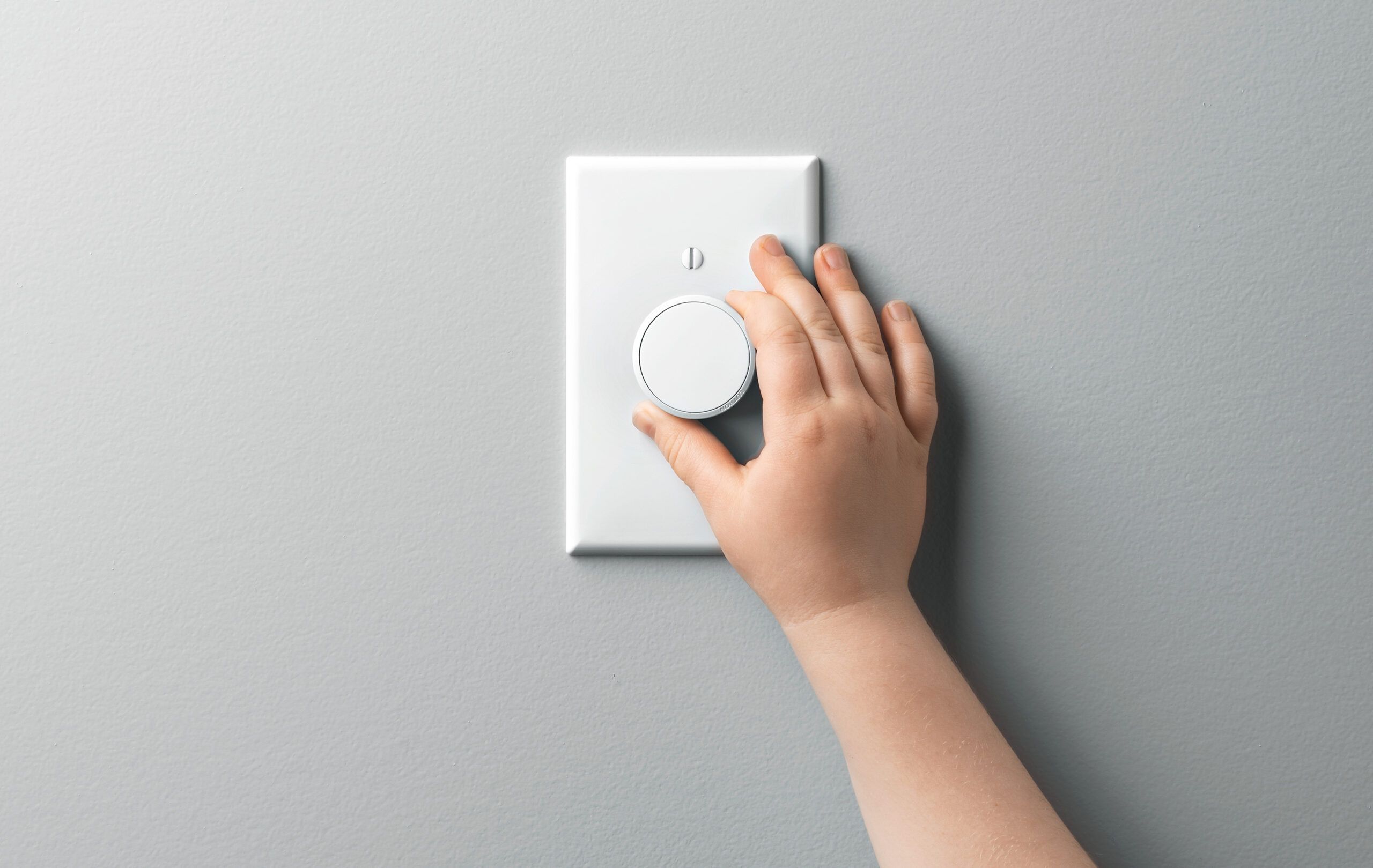
You should only install a dimmer yourself if you have specialized knowledge. Installing one is worth it if you want to adjust the brightness of incandescent bulbs. Here, we’ll explain how a professional performs the installation and how you can find a modern universal dimmer for traditional bulbs as well as dimmable LED and halogen bulbs.
Installing a dimmer: How experts do it
Because working with electrical current can be dangerous, according to information from TÜV-Nord, from a legal standpoint and in accordance with a VDE standard, only licensed electricians are permitted to install fixed electrical switches. If you decide to install the dimmer yourself anyway, you should be aware of the dangers and risks. As an experienced DIY enthusiast, you can help with the preparations, such as purchasing the necessary supplies. The following seven steps show how to remove traditional on/off switches and install universal flush-mounted dimmers.
- Turn off the power: To avoid dangerous electric shocks during installation, unscrew the relevant fuse or turn off the power using a toggle switch.
- Secure the fuse: Everyone else in the household must be informed about the electrical work so that they do not turn the fuse back on in the meantime.
- Check that the wires are de-energized: Experts use a voltage tester to check all involved wires to ensure that not a single wire is still carrying current.
- Remove the old switch: After removing the covers, unscrew the traditional on/off switch from the flush-mounted box. The blue cable, which serves as the neutral conductor and is labeled “N,” and the yellow-green cable, which serves as the ground wire “PE,” are normally not connected to the switch.
- Removing wires from the old switch: The brown (and sometimes black) wires—which carry the current to the switch as the live wire or phase “L” and continue from there to the light fixture—are usually the ones being switched. Experts pull these two brown wires out of the old switch.
- Connecting the dimmer to the circuit: The brown (or sometimes black) wire coming from the power source is inserted into a terminal on the dimmer marked with an arrow pointing straight up or labeled “L.” The other brown wire, which runs from the dimmer to the light fixture, must be connected to the terminal marked with a sine wave and an arrow pointing up and to the right.
- Installing the dimmer in a flush-mounted box: The now-connected dimmer is slid into the flush-mounted box and secured there with two screws.
The cover plate must be placed over the rotary control’s shaft and secured with a retaining ring. Placing the rotary knob onto the same shaft completes the installation.
Dimmers – Current Models
- With the rotary switch, the power can be adjusted from 1 to approx. 200 watts or from 1 to approx. 350 watts for flush-mounted dimmers, and from 1 to approx. 60 watts for pull-chain dimmers.
- Pressing the rotary switch turns the 230-volt power on and off.
- With flush-mounted dimmers, in addition to “normal” on/off operations, two-way switching is also possible in combination with an additional two-way switch.
- The dimmer and the lamps do not hum or beep during operation.
- Any flickering of the light bulbs can be prevented by fine-tuning the dimmer.
- An illustrated, easy-to-understand German user manual for the dimmer is available.

Dimmable Light Bulbs and Outlets
The range of dimmable light bulbs has expanded significantly in recent years. To ensure that your lighting systems function properly, you must make sure that the light bulbs and dimmers you use are actually compatible.
- In the past, only traditional incandescent bulbs could be used with older dimmers.
- Many older LED and halogen bulbs were not dimmable. Even today, some LED bulbs require special dimmers. Only the newer models work well with universal dimmers.
- If an LED flickers, it’s usually due to an incorrect LED bulb or an incompatible dimmer.
- Dimmable bulbs with remote controls or control via special apps open up a wide range of possibilities (including color-changing options).
- In addition to flush-mounted dimmers and pull-chain dimmers, there are also dimmable outlets, which are used less frequently.
- The basic models of dimmable outlets can be operated manually (just like flush-mounted dimmers) using rotary switches.
- The very convenient dimmable wireless outlets can be controlled via remote control or special apps.