258
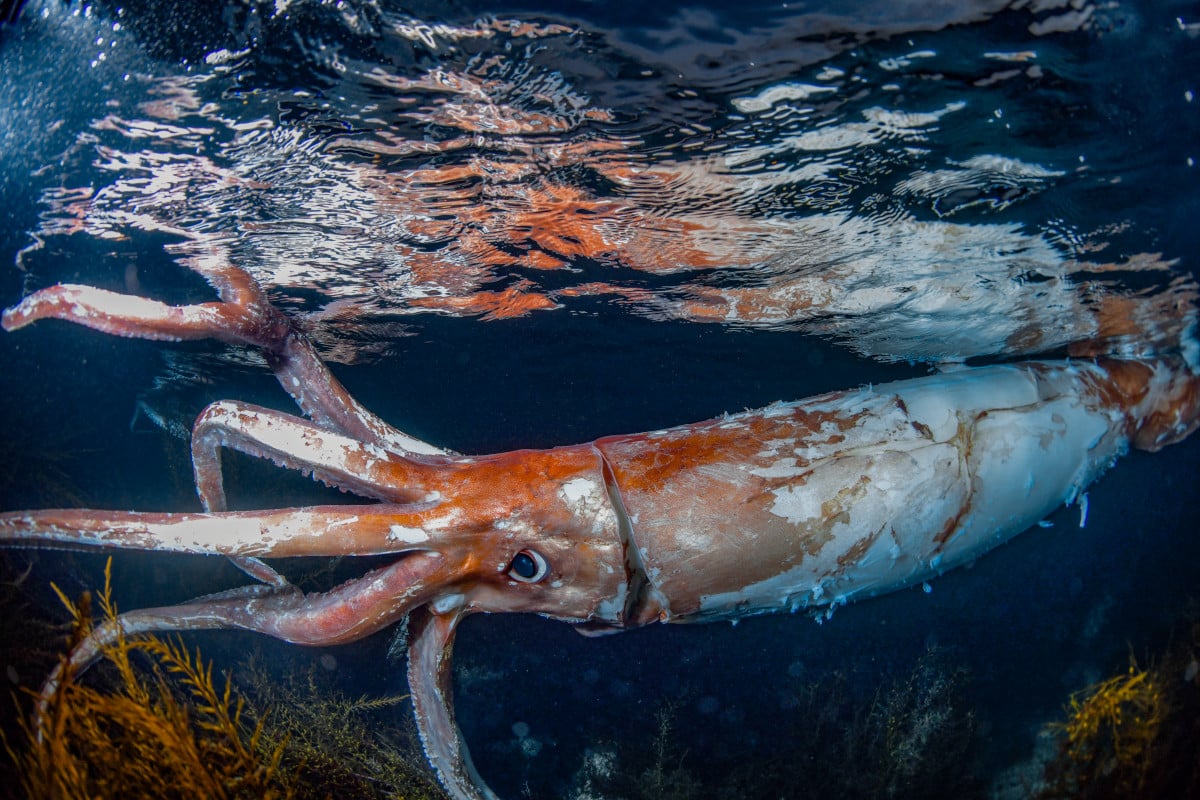
Giant squids can grow up to 18 meters long and weigh half a ton. This makes them the largest cephalopods.
Size of giant squids: All the info
Giant squids are the largest known mollusks and are called Architeuthis dux in Latin.
- It is believed that these animals can grow up to 18 meters long . However, exactly how large these giants actually grow is not precisely known, as giant squids are extremely difficult to find. Furthermore, the extreme elasticity of their arms poses a challenge when measuring them.
- Unlike the octopus, the giant squid has two additional tentacles in addition to its eight sucker-covered arms; these serve as extended hunting arms and are equipped with hooks. The giant’s arms alone can reach a length of up to nine meters.
- The animal’s largest organs are its eyes, which are about the size of a basketball. It needs these gigantic eyes to find prey in the darkness of the deep sea and to protect itself from predators.
- With its impressive size, the giant squid can also exert enormous strength. Its prey is easily held in place by suction cups up to ten centimeters in size. There are even reports of scars and marks on the skin of sperm whales caused by the suction cups of giant squids.
- But it is not only its incredible strength that protects the giant squid from predators. To camouflage itself, this cephalopod can change color. It also has the ability to inflate its skin to appear larger and deter predators.
Where giant squids live
Giant squids are fascinating not only because of their size. Squids possess remarkable intelligence, enabling them to even use tools. Their social behavior is also highly developed.
- These colossal cephalopods are found in the waters around Norway, Great Britain, and Newfoundland. They also exist off the coasts of Australia, New Zealand, South Africa, and Japan. It is believed that these animals live at depths of 300 to 1,000 meters, where there is no sunlight or vegetation.
- Although giant squids look terrifying, they are harmless to humans. For one thing, giant squids almost never stray into coastal waters; for another, humans simply do not fit their hunting profile.
- Little is known about their hunting behavior either. Giant squids feed primarily on smaller cephalopods. During stomach examinations, researchers found remains of smaller squids and fish.
- Fossil finds prove that these massive squids existed over 500 million years ago, making them among the oldest creatures on our planet, having lived even before the dinosaurs.

Giant squids: Legends, myths, and stories
Stories and legends about gigantic cephalopods that attack and sink ships exist in many cultures. The myth of the giant squid can even be found in literature and films. However, scientific findings have already proven that the giant squid really does exist.
- The term “giant octopus” is often mistakenly used as a synonym for the giant squid. This confusion dates back to the Swedish bishop Olaus Magnus, who referred to the cephalopod as a “krake” in the 17th century.
- As early as in his Odyssey , Homer describes Odysseus battling Scylla. Scylla is a sea monster with the upper body of a woman. Her lower body is embedded in a rock, and she possesses numerous arms with which she catches sea creatures and sailors. This description is reminiscent of the legend of the giant squid.
- Numerous whalers and sailors reported giant squids found in the stomachs of sperm whales. Around 1861, the crew of the French warship “Alecton” reported seeing a dead giant squid floating in the sea near Tenerife. The animal is said to have been twelve meters long.
- In 1830, the British poet Alfred Tennyson published the poem “The Kraken,” which tells of a gigantic cephalopod.
- The giant squid also appears in Jules Verne’s novel “20,000 Leagues Under the Sea.” Mistakenly, the corresponding chapter in the German translation is titled “The Attack of the Kraken,” even though the novel’s illustrations clearly show a giant squid with the characteristic tentacles that kraken do not possess.
- The element of the fearsome cephalopod also plays a role in many films. These include the “Pirates of the Caribbean” series and the film ‘Octopus’ (2000), but even in “The Little Mermaid,” the evil sea witch resembles a kraken.