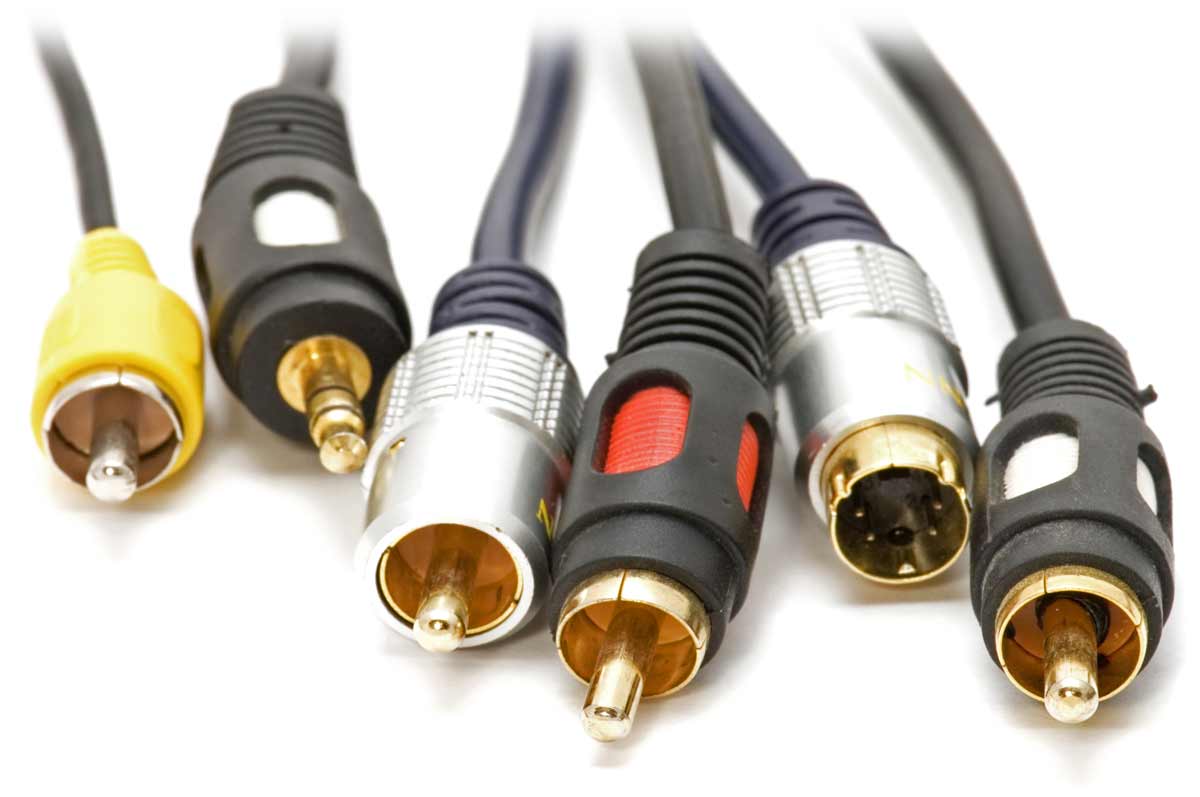
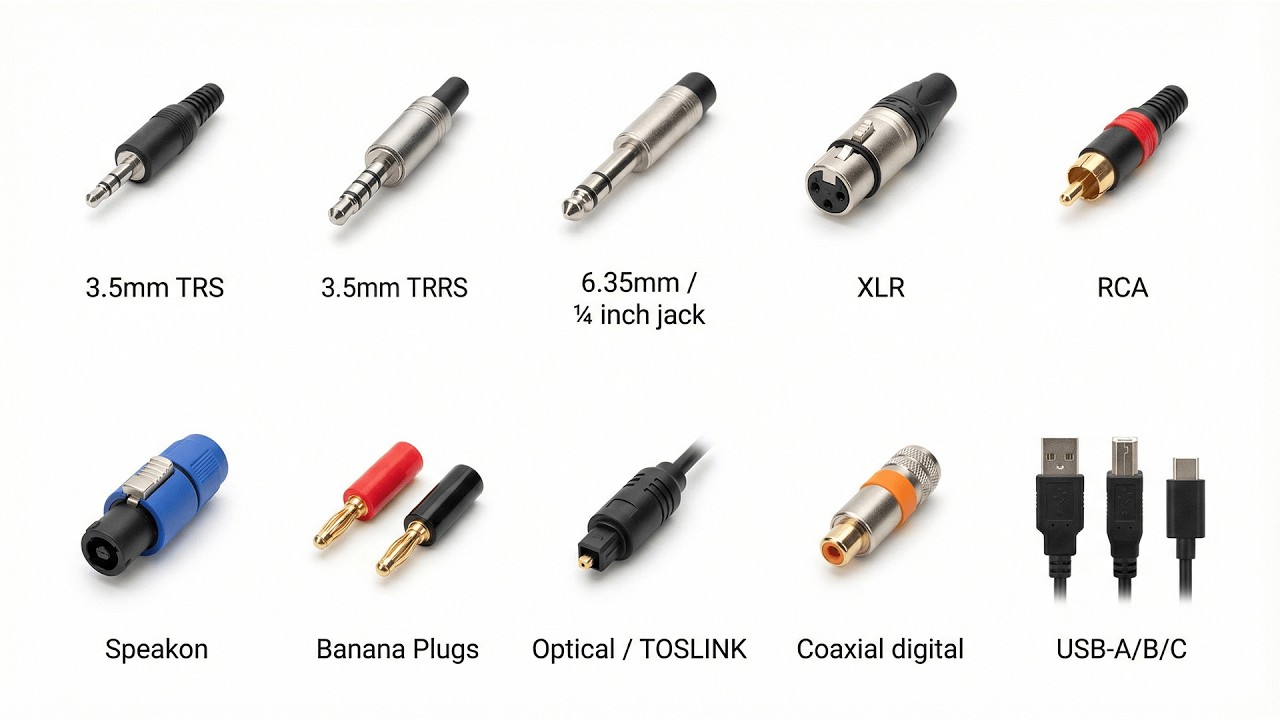
Some audio connectors are widely used, whilst others are rather unusual. However, they all have specific advantages and characteristics, and many can be converted into one another using adaptors. In this practical guide, we’ll introduce you to the various audio connectors and their differences. In the accompanying picture gallery, we’ll show you photos of the respective plugs and sockets, as well as the adaptors.
Widely used: The audio jack connector
The audio jack comes in various sizes and designs and is found in radios, computers, microphones and other devices.
- The most common are 3.5 mm and 3.6 mm audio plugs and sockets.
- Depending on the design, they carry two, three or even more wires, separated by rings. When plugged in, the wires may occasionally be temporarily short-circuited, which can be heard as a crackling sound.
- With three conductors, either two channels are typically transmitted asymmetrically (as with most stereo headphones) or one channel is transmitted symmetrically. This flexible configuration is one of the strengths of the audio connector.
- The 3.5 mm jack, in particular, is widely used and space-saving. This is another of its strengths.
- In further practical tips, we’ll show you how to repair jack cables and solder headphone cables.
RCA connectors in the audio-video sector
RCA connectors are particularly common in the audio-video sector, as the yellow video cable is very widely used here. In further practical tips, we’ll look in more detail at the differences between RCA and jack plugs and show you how to solder RCA plugs.
- RCA has been widely used, at least since the rise of analogue video cameras and video recorders.
- Usually, the red cable carries the right-hand audio channel, the white cable the left-hand audio channel, and a yellow cable carries the video signal.
- As there is one wire inside the plug and one on the outside, you will not cause a short circuit whilst plugging it in.
- As only one channel can be transmitted unbalanced, RCA is not very flexible and is comparatively prone to interference. Nevertheless, due to its widespread use, RCA is often found in professional equipment as well.
The deluxe audio connector: XLR for audio professionals
XLR is found almost exclusively in the professional audio sector. In a practical tip, we explain the exact differences between jack plugs and XLR:
- XLR plugs are significantly larger than other standard audio plugs.
- Typically, a single channel is transmitted symmetrically via three wires. This ensures minimal noise from electromagnetic interference, even over long cable runs.
- In most condenser microphones, one of the wires carries the power supply and the other carries the signal.