These Dinosaurs Lived in Water
Dinosaurs that lived in the water are also called marine dinosaurs. There were many different species. Most can be divided into three orders: Sauropterygia, Ichthyopterygia, and Mosasauria.
Plesiosaurs – Family of the Sauropterygia
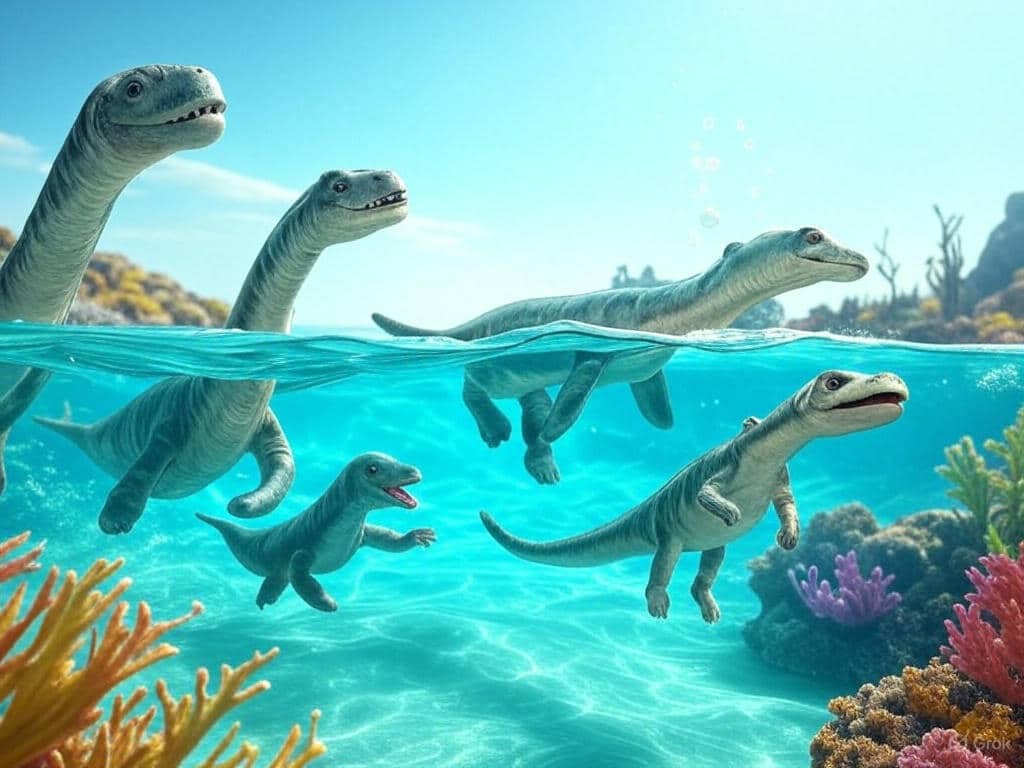
Plesiosaurs are also known as “Elasmosaurs” and belong to the Sauropterygia family, which lived during the Cretaceous and Jurassic periods. They had a gigantic, voluminous body and a very long neck, which made it easier for them to catch their prey. As carnivores, their diet consisted mainly of fish and mollusks.
- Facts: It was a carnivore, lived during the Cretaceous and Jurassic periods, had a body length of up to 15 meters, and was found primarily in Asia and North America.
- This marine giant had a very voluminous body and a long, slender neck. Its tail, fin-like legs, and small head helped it move through the water.
- For a long time, it was believed that the plesiosaur belonged to the reptile family. However, research revealed that the dinosaur’s body was unable to leave the water to lay eggs on land. The theory that followed was that the dinosaur gave birth to live young.
- At 15 meters, the plesiosaur was one of the largest marine dinosaurs. Through wing-like movements of its flippers, however, the giant was still able to move quickly through the water. This is also known as marine “flight.”
The Ichthyosaur
Ichthyosaurs lived in the waters from the Triassic through the Cretaceous periods. Their appearance suggests that they belong to the same family branch as our modern-day dolphins. However, this has not been confirmed.
- Facts: Ichthyosaurs were carnivores; they lived from the Lower Triassic through the Upper Cretaceous and reached a body length of up to 18 meters. Fossils have been found in the seas of India, Europe, the Caribbean, and North America.
- The ichthyosaur had a fish-like body, a head like a lizard’s, and fins like those of whales and dolphins.
- Its huge eyes allowed it to spot objects from great distances and in challenging ocean conditions. This enabled it to hunt at night when most prey were asleep.
- The Ichthyosaurus was an air-breathing animal, which means it had to surface to breathe, just like dolphins.
- It was a fast, endurance swimmer and a deep diver, which allowed it to chase its prey over long distances.
- Fossils of the Ichthyosaurus have been found containing live offspring inside.
This suggests that it also gave birth to live offspring.
Liopleurodon
The Liopleurodon is a well-known marine dinosaur of the Sauropterygia. It was characterized above all by its large teeth, which made it a dangerous predator.
- Key facts: It was a carnivore, lived from the Lower Triassic to the Upper Cretaceous, could grow up to 12 meters long, and was found in Europe (England, France, Germany).
- Liopleurodon reached an average length of 12 meters, with the skull alone measuring 2.2 to 3 meters.
- Liopleurodon was a visual predator. Its brain accounted for less than 1 percent of its body mass and therefore had to process information very quickly. This type of brain is also found in today’s great white shark.
- Its strong and long front and rear fins suggest that it was a powerful swimmer.
- Liopleurodon had a strong jaw with powerful teeth. This suggests that its diet consisted less of fish and more of larger prey.

Hainosaurus
Hainosaurus belongs to the genus of mosasaurs from the Late Cretaceous period.
- Facts: It was a carnivore, lived during the Late Cretaceous period, reached a body length of 12–17 meters, and was found in Europe, Canada, and Antarctica.
- The 1.5-meter-long skull was pointed and reinforced. Researchers believe it was used to incapacitate or kill rivals or prey by ramming them.
- With a length of up to 17 meters, Hainosaurus is considered one of the largest mosasaurs.
- The marine dinosaur likely hunted other large marine animals such as turtles, smaller mosasaurs, and, as an adult, possibly also large fish and sharks.