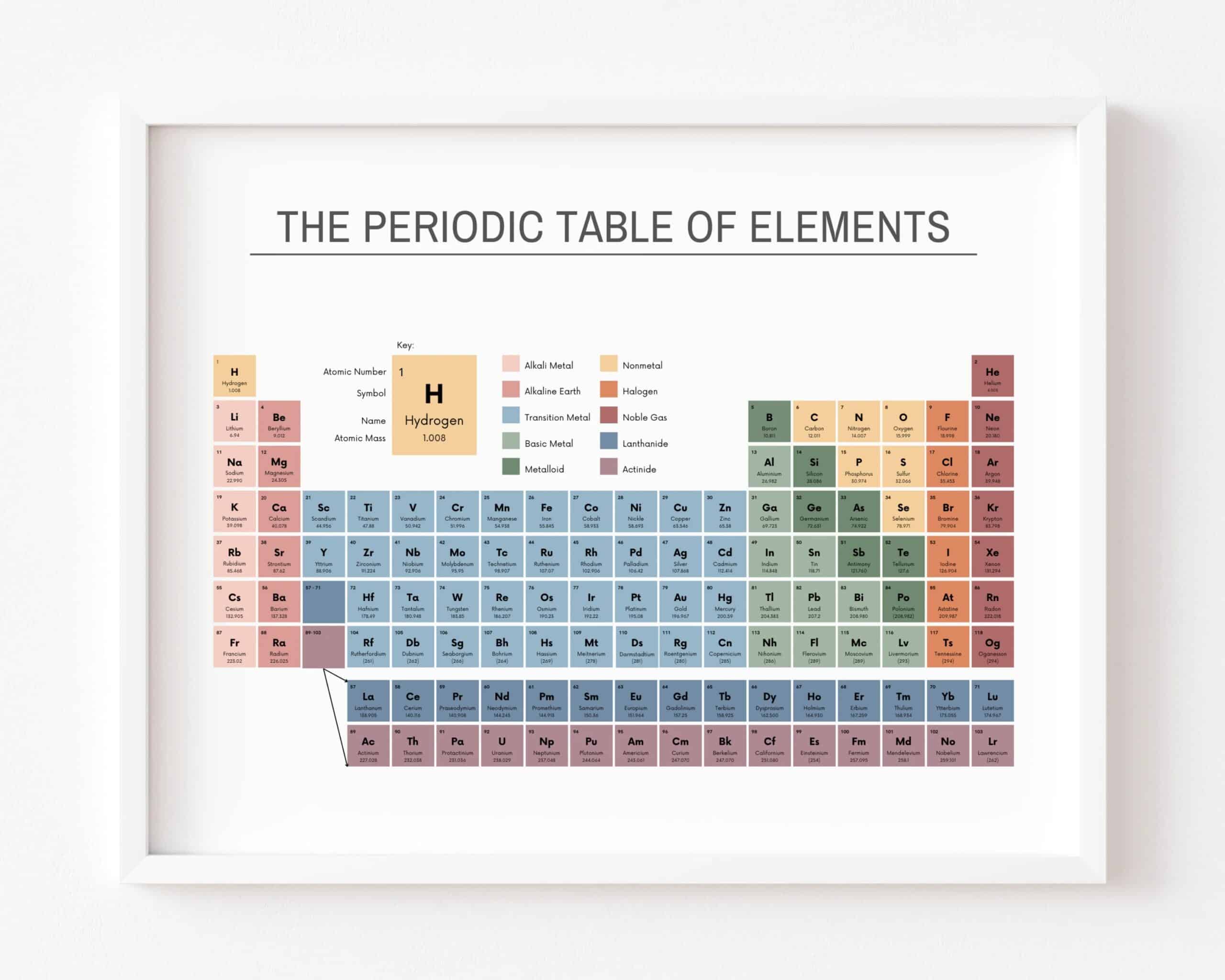
The periodic table of elements is indispensable for chemistry classes or when studying chemistry. In this article, we’ll tell you where to find a free template to print.
Printable Periodic Table of the Elements
You’ll find many templates for the periodic table online, but not all of them are accurate or complete. Be sure to check that your template includes all the important data, such as atomic number, mass, atomic radius, electronegativity, and melting and boiling points.
- Then open the downloaded file in a PDF viewer such as Adobe Reader. You can then print the periodic table using the keyboard shortcut [Ctrl] + [P].
- Tip: In your printer settings, set the format to “Borderless” and select “Landscape” to print the periodic table across the entire A4 page.
Structure, Significance, and Applications of the Periodic Table
The periodic table arranges all known chemical elements in order of increasing atomic number and groups elements with similar properties together.
- The atomic number indicates how many protons are in the nucleus of an element. It thus determines which element it is and defines its position in the periodic table.
- The periodic table thus enables a better understanding of atomic structure, chemical bonding, and reactivity.
- In chemistry and other natural sciences, the periodic table serves as an important guide for determining material properties or identifying scientific relationships.
- But the periodic table also serves as the foundation for innovations and problem-solving in practical applications such as materials research, medicine, environmental engineering, and pharmacy.

How to Use the Periodic Table While Studying
By using the periodic table in a targeted and practical way, you can understand complex concepts more easily and retain them long-term. Here’s an overview of the most important tips:
- Create your own colored markings or symbols on the periodic table to better distinguish between groups such as metals, nonmetals, or noble gases and recognize them more quickly.
- Use flashcards with element names, symbols, and important properties to acquire knowledge in a targeted way and practice retrieving information.
- Use digital tools or apps that provide interactive periodic tables to make learning varied and engaging.
- Connect theoretical knowledge with everyday experiences by thinking about where chemical elements are found in daily life—for example, aluminum in foil or sodium in table salt.
- Discuss the elements and their properties with your classmates and explain them to one another. Actively sharing knowledge helps reinforce your own memory.