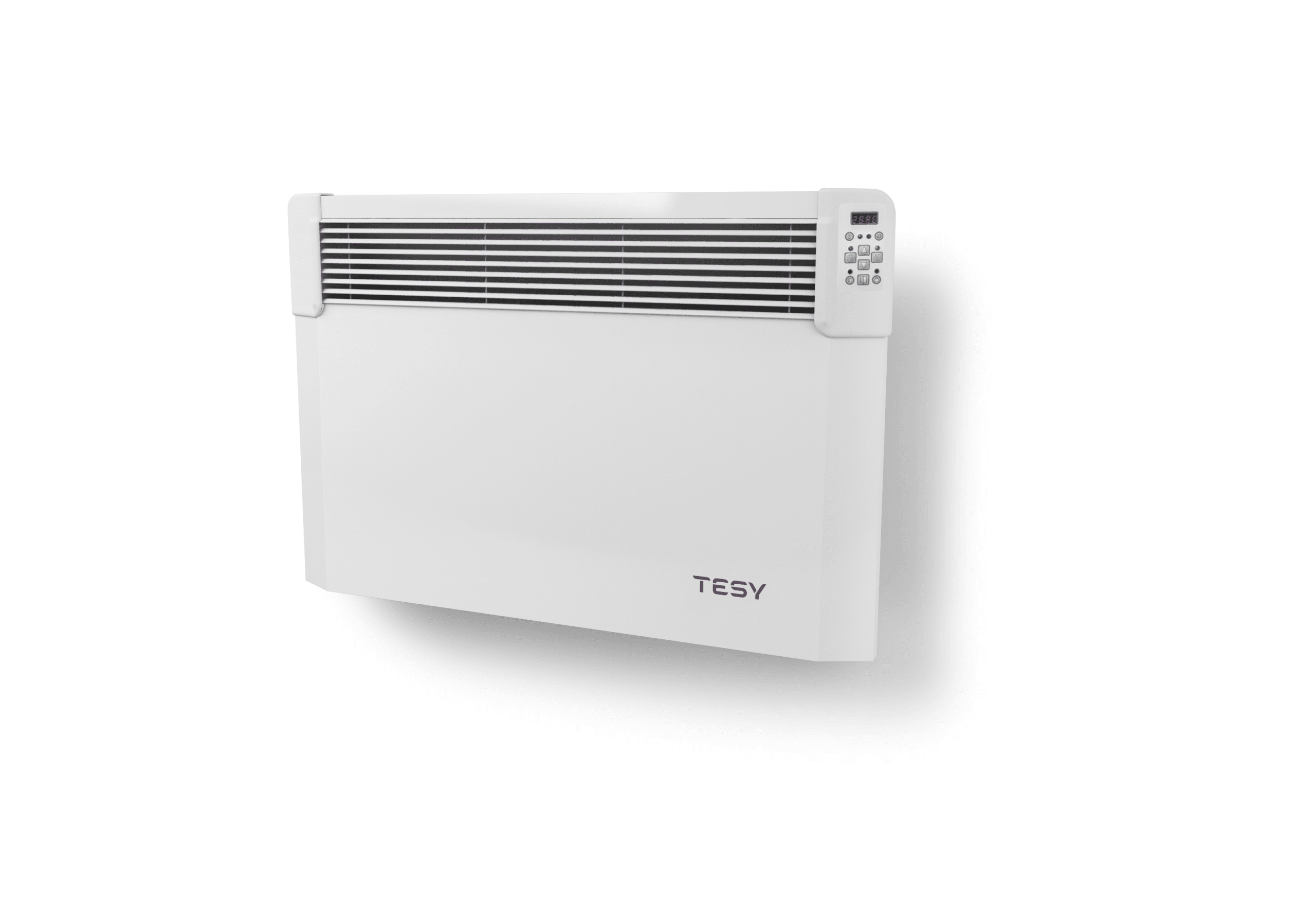
If you use a convector heater as your primary heating source, you should be aware of its high electricity consumption. Learn more here.
Electricity Consumption and Costs of a Convection Heater
A convection heater works with electrically heated wires through which air is drawn in, heated, and then released back into the room. This allows a room to heat up very quickly—though at a comparatively high energy consumption.
- Here’s an example: A convector heater with a 1,500-watt output consumes 1.5 kilowatt-hours of electricity per hour. If it’s used in a home office for about eight hours a day, that results in a daily consumption of around 12 kilowatt-hours. At an average electricity price of about 39.6 cents per kilowatt-hour (as of 2025), this results in daily costs of around 4.75 euros.
- For comparison: A smaller convector heater with a power output of 1,000 watts consumes about 5 kilowatt-hours when used for five hours, amounting to roughly 2 euros in electricity costs per day.& nbsp;A more powerful 2,000-watt model running for four hours requires about 8 kilowatt-hours, or just over 3 euros per day.
- These figures illustrate that operating a convector heater over extended periods has a significant impact on the electricity bill. As a permanent primary heating source, it is therefore not cost-effective in most households. It is primarily recommended for short-term heating of individual rooms that are rarely used or have no other heat source.
Comparison of a convector heater with other types of heating
Compared to other heating systems, convector heaters are less efficient because they convert electricity directly into heat.
- Infrared heaters do not heat the air, but rather objects and people in the room. This creates a different sensation of warmth, which is often perceived as more pleasant. A 700-watt infrared heater consumes about 3.5 kilowatt-hours when used for five hours a day—less than a typical convection heater. Nevertheless, operating costs are still higher than those of modern heat pumps.
- Heat pumps utilize environmental heat from the air, soil, or groundwater. On average, they generate three to four kilowatt-hours of heat from one kilowatt-hour of electricity, making them significantly more efficient. The initial cost of the system is higher, but it pays for itself over the years due to lower electricity consumption. In addition, many heat pumps can also be used for cooling in the summer.
- Fan heaters are similar in design to convector heaters, but usually operate without a fan to circulate the air, making them slightly noisier and less efficient. They are only suitable for short-term heating of small rooms.

Efficiency, advantages and disadvantages in continuous operation, and current developments
Convector heaters offer several advantages: They are ready for use quickly, are inexpensive to purchase, and do not require complex installation—a single outlet is all that’s needed. This makes them particularly practical for garden sheds, vacation homes, or as a temporary solution in poorly heated rooms.
- However, significant disadvantages become apparent during continuous operation: Electricity consumption is high, which not only puts a strain on your wallet but also on the environment, unless the electricity comes from renewable sources.
- In addition, the constant heating and circulation can quickly dry out the air, which affects the indoor climate. If the heater is turned on only occasionally and the room subsequently cools down significantly, this can promote moisture buildup on cold walls—a risk for mold growth.
- Efficiency Tips: Use timers or thermostatic outlets to schedule operation. Heat only rooms that are actually in use and keep doors closed to prevent heat loss.& nbsp;Also, improve the insulation around windows and doors to reduce heating needs. Additionally, it’s advisable to use convector heaters only with green electricity or as supplemental heating to a more energy-efficient primary heating system.
- Current developments: Electricity prices in Germany will average around 39 to 40 cents per kilowatt-hour in 2025. In some regions and with certain rates, prices as low as 30 cents are also possible. Subsidy programs currently focus on energy-efficient heating systems such as heat pumps or building renovations. There is generally no government subsidy for purely electric direct heating systems, such as convectors, as they are considered less efficient compared to other heating methods.