287
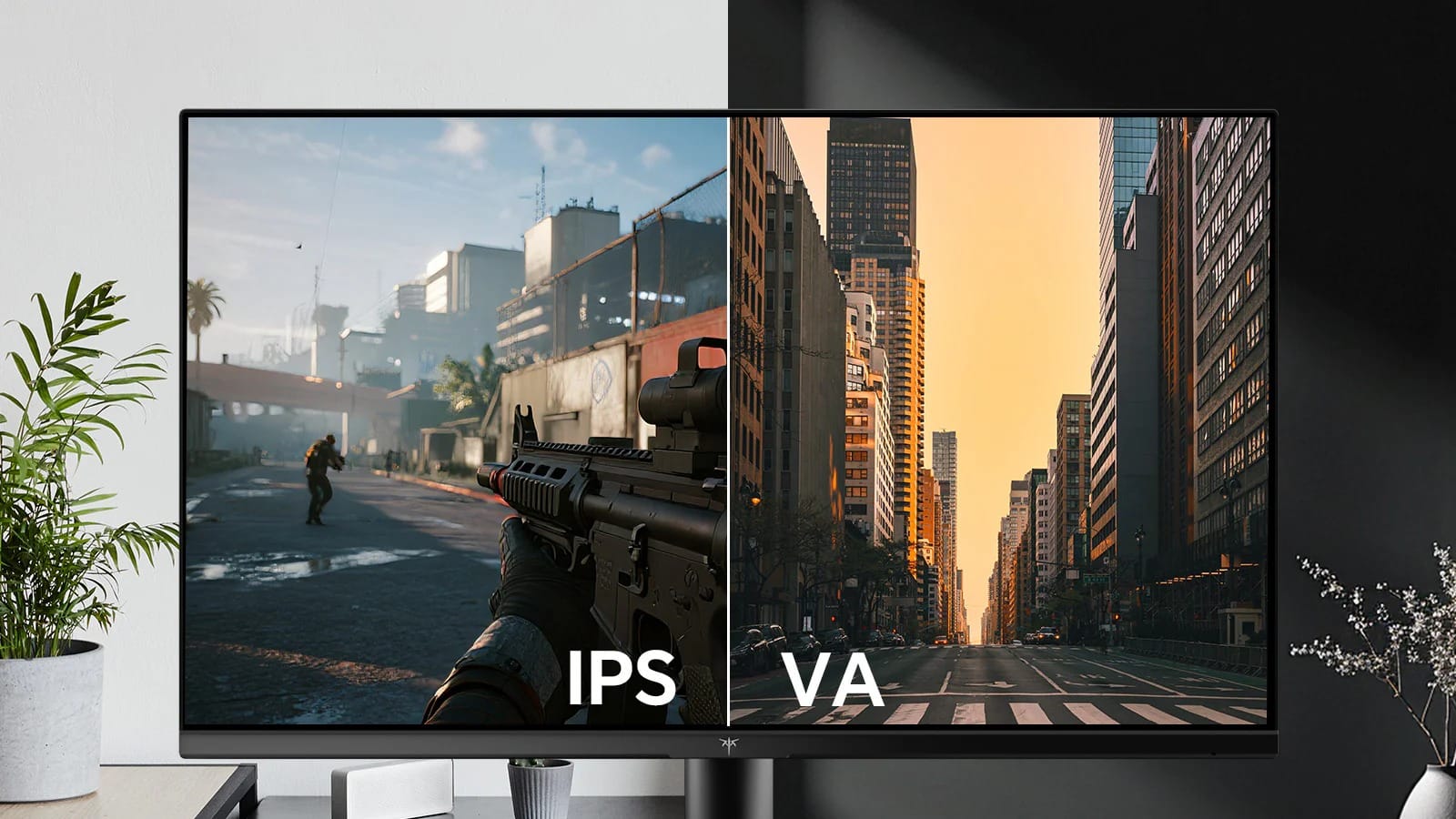
IPS or VA: With LCD displays, you often have the choice between these two panel types. Each technology has its own advantages and disadvantages.
IPS or VA Panel: What’s the Difference?
- Contrast: VA panels offer significantly higher contrast (up to 6,000:1) and deeper blacks, making them ideal for movies and dark scenes. IPS panels only reach about 1,000:1 and tend to display black as a dark gray
- Color reproduction: IPS panels impress with more precise and vibrant colors as well as better color accuracy, which is why they are the preferred choice for photo and video editing. VA panels also offer good colors, but are slightly less accurate.
- Viewing angles: IPS panels have nearly perfect viewing angle stability (178°), while VA panels lose contrast and color intensity when viewed from the side.
- Response time: IPS panels are faster and better suited for gaming, as they minimize motion blur. VA panels have longer response times, which can be distracting during rapid scene changes.
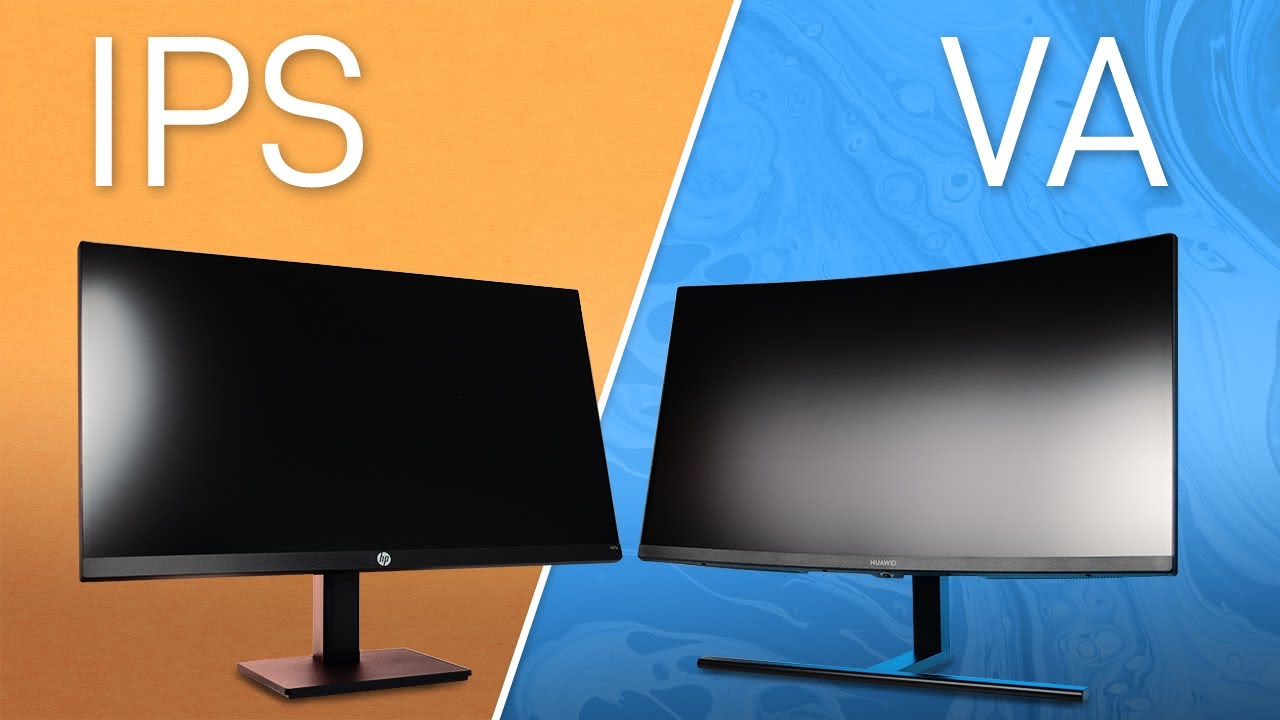
Which panel is better?
In an IPS panel, the crystals are arranged uniformly on top of one another and only need to rotate—rather than move spatially—to change the display. This results in significantly shorter response times for IPS panels, which is particularly important for gaming.
- Due to the uniform arrangement of the crystals, the viewing angle is also significantly wider and more stable. Even though the contrast is higher on a VA panel, the IPS panel delivers a wider color gamut. The IPS panel also performs better in terms of power consumption.
- If a VA panel is touched, it reacts much more strongly to the disturbance and flickers, which is generally undesirable. If you swipe your finger across a VA panel, you can briefly leave a trail; with an IPS panel, this is not possible at all under ideal conditions.
- When panels are exposed to high temperatures, the IPS panel also proves its worth. Older VA panels can develop black spots—so-called hotspots—when exposed to temperatures of 57 degrees Celsius or higher. Although these disappear once the panel cools down, in some cases this can lead to permanent damage to the panel. Modern VA panels, on the other hand, are less prone to hotspots.
- IPS panels are generally more expensive than VA panels because they are more complex to manufacture and offer better color and viewing angle stability.
VA panels are priced between TN and IPS panels. They are less expensive than IPS panels but offer solid performance in terms of contrast and color accuracy. However, the total price of the monitor also depends on many other quality factors, such as the materials, refresh rate, and resolution. - In short: IPS panels offer the best color accuracy, wide viewing angles, and fast response times. The drawbacks are low contrast and higher cost. VA panels excel with high contrast, deep blacks, and a lower price. However, their response times are slower and their viewing angle stability is limited.
- Conclusion: IPS panels are ideal for professional applications such as photo and video editing, as well as for users who value color accuracy and wide viewing angles. VA panels offer better value for the money and are particularly well-suited for movies or games with dark scenes where high contrast is important. Ultimately, the choice between IPS and VA depends on the user’s individual needs.