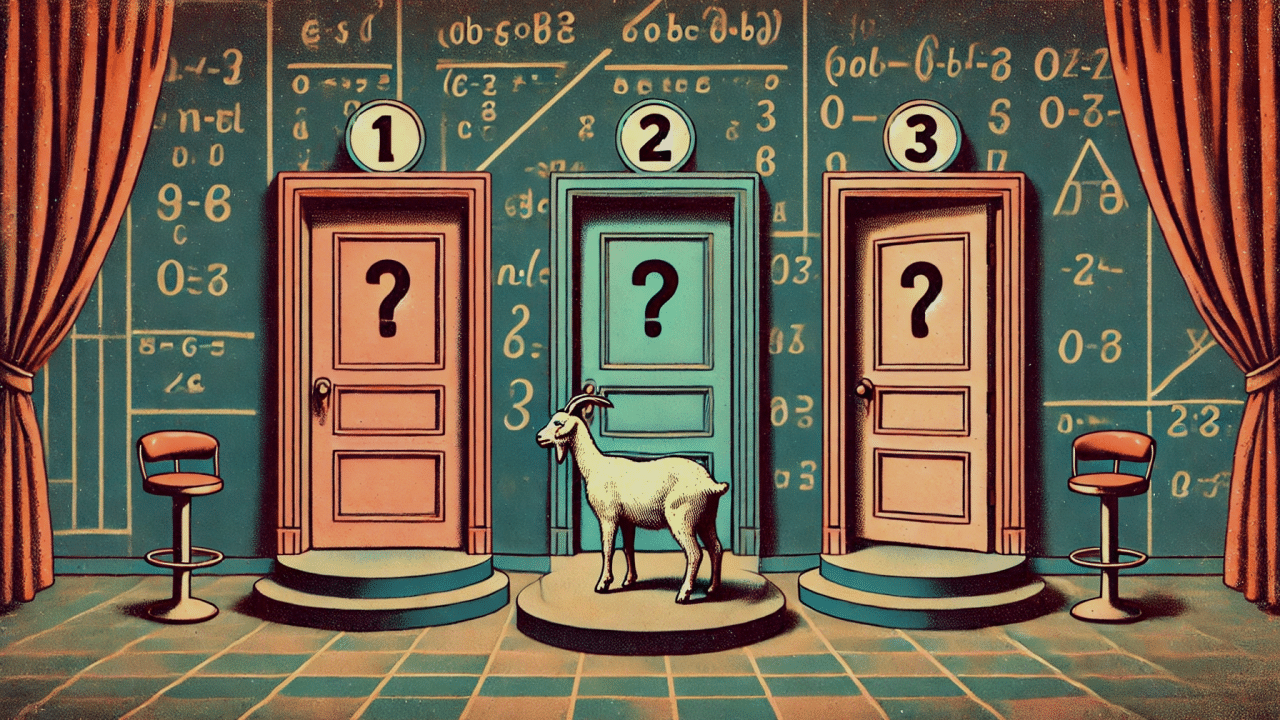
The Goat Problem has been stirring up debate worldwide since the 1990s. Yet the solution to the Goat Problem is relatively simple if you use the right explanation.
The Goat Problem: What Is It, Anyway?
The Goat Problem is also known as the “Monty Hall Problem.” Monty Hall hosted the show “Let’s Make a Deal” back in the 1960s. In Germany, the show has been known as “Geh aufs Ganze” since the 1990s.
- On the show, the contestant has the option to choose between three doors. Behind one door is the grand prize; behind the other two doors is a loser: the goat.
- In this game of chance, the contestant selects a door. The host, who knows which door hides the grand prize, tries several times to get the contestant to change their mind. The host’s behavior is part of the show and occurs even when the unsuspecting contestant has already settled on a blank.
- In the “Goat Problem,” the following happens: For example, the contestant has chosen Door 1. The host opens one of the other two doors, revealing a goat behind it, and asks the contestant one last time if they’d like to switch doors. The controversial question is: Should you switch doors, or not?
Why is the Goat Problem so widely debated?
The discussion about the Goat Problem first erupted in 1990. American author Marilyn vos Savant—the woman with the highest IQ ever recorded—had published the problem in a magazine.
- However, the solution to the problem—whether switching doors is really worth it—wasn’t understandable to most people. Even many mathematicians and statisticians long disputed Marilyn vos Savant’s logic.
- At first glance, it seems to make no difference at all which door you choose. We know that behind one door is the second goat and behind the other door is a car. No matter which door you choose, the probability is always 1 in 2. As logical as that may sound at first, it is not correct.

Explained Simply: The Solution to the Goat Problem
The goat problem only became so popular because hardly anyone understood the complex and incomprehensible attempts at explanation. It wasn’t until several years later that the perspective on the problem was changed and an easy-to-understand solution was published. What’s important for deciding whether to switch isn’t just the contestant’s perspective, but also the host’s. The following three scenarios are equally likely to occur:
- Case 1: The car is behind Door 1. In this example, the contestant chose Door 1, so switching doesn’t make sense.
- Case 2: The car is behind Door 2. In this case, the host must open Door 3, since he is not allowed to reveal either the contestant’s choice or the car. For the contestant, switching to Door 2 makes sense, since that is where the car is.
- Case 3: This case is identical to Case 2. The car is behind Door 3. In this case, the host must open Door 2, since he is not allowed to reveal the contestant’s choice or the car. For the contestant, switching to Door 3 makes sense, since that is where the car is.
- If you look only at the outcomes of the three cases, it becomes clear: In Case 1, switching doors makes no sense; in Cases 2 and 3, however, switching does make sense. Thus, the probability of winning increases from 1:2 (50 percent) to 2:3 (66.6 percent) if the contestant switches doors.