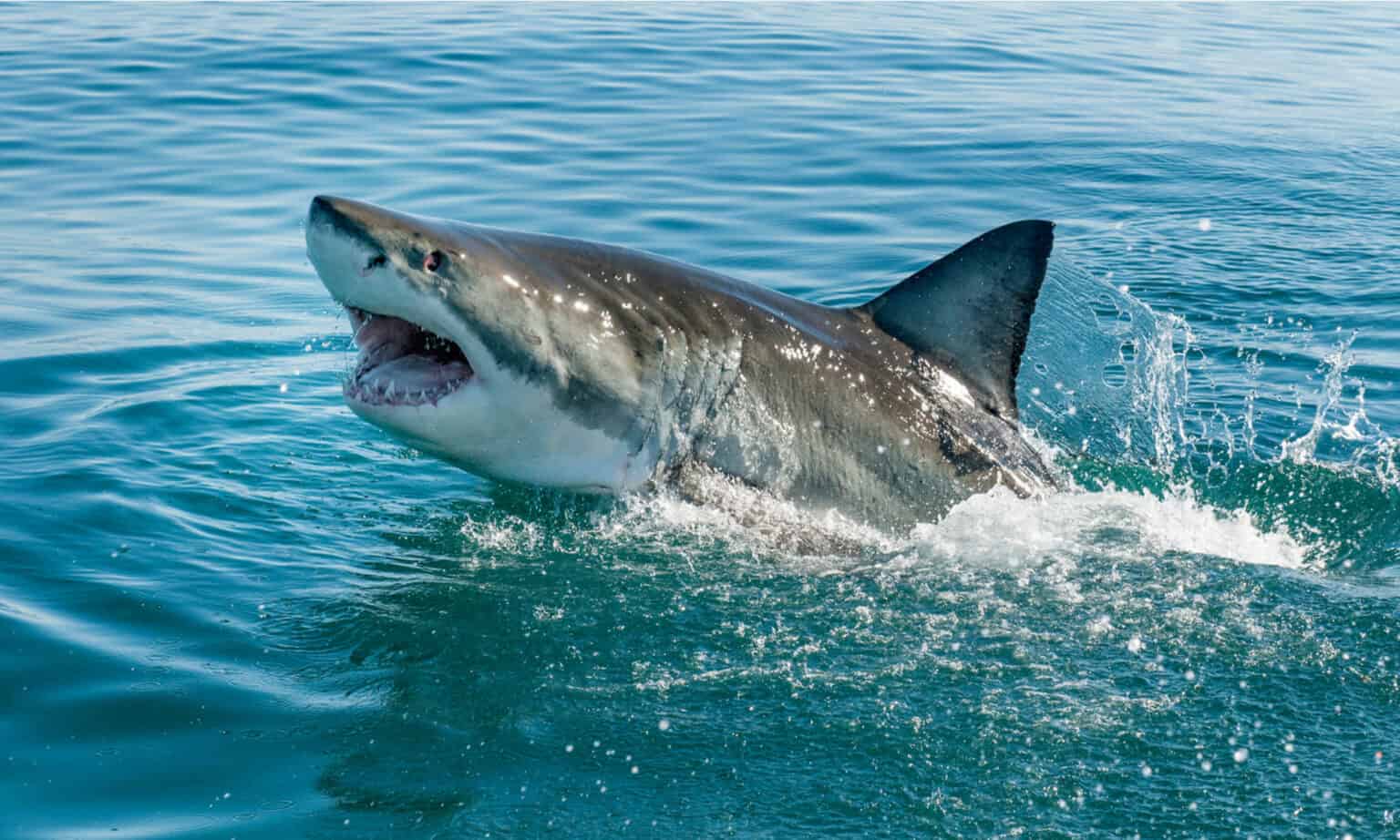
The shark is not a mammal, but a fish. However, the majority of sharks give birth to live young, which is actually seen as a characteristic of mammals.
Is the shark a mammal or a fish?
You might think that the shark – just like the mostly peace-loving dolphin – is a mammal and not a fish. However, this is wrong, because sharks are cartilaginous fish. Cartilaginous fish are a superclass of vertebrates, which also includes rays and chimaeras,
for example.
- As the name suggests, the skeleton of this class consists of cartilage. Their skin is covered with scaly teeth, the so-called placoid scales.
- In addition, sharks have gill slits and no lungs, which is typical of cartilaginous fish. Their respiration only works if they remain actively moving and thus maintain the flow of water through the gills;
- In addition, sharks have an alternatively warm body temperature, which means that their body temperature fluctuates with the outside temperature. Mammals, on the other hand, are equally warm and have a constant body temperature.
- Mammals also belong to the class of vertebrates. Other characteristics of mammals in addition to the constant body temperature, are breathing through the lungs. They also give birth to their children alive and suckle them at the breast.
- It is precisely this last point where there is a risk of confusion, as around a third of all shark species also give birth to live young. Only around 30 percent lay eggs, including spiny dogfish and catsharks, for example. The eggs are surrounded by a horn-like egg capsule with filamentous outgrowths, which gives them an unusual shape and means they are not immediately recognized as eggs.
- Since sharks reproduce very slowly, the losses caused by hunting and overfishing can hardly be compensated for. According to ARD more than three quarters of all sharks are endangered.
Special characteristics of sharks
Sharks are fascinating animals. They lived before the dinosaurs and are still perfectly adapted to life in the ocean today. From films such as “Jaws” (1975) or “Megalodon” (2018), we know sharks as fearsome manhunters, but this is a misconception.
- Like some other fish and amphibian species, sharks have a lateral line organ. This enables them to precisely locate and identify an object that is moving.
- In addition, sharks are able to perceive electrical fields. They have electrosensors called Lorenzinian ampullae, which are only found in sharks and rays. A shark has numerous ampullae on its snout in particular, which are visible as pores. The Lorenzinian ampullae enable the shark to detect prey.
- Another special feature of sharks is their revolver teeth, which consist of several rows of teeth. If a tooth breaks off, it is replaced by a new one. This means that a shark can use up to 30,000 teeth in the course of its life.
- The cartilaginous fish have an extremely keen sense of smell. Among other things, they can detect blood from a distance of up to 400 meters. However, it is a myth that the smell turns them into bloodthirsty hunters.
- Some shark species, such as the whale shark, can live to be more than 100 years old. Greenland sharks can even live for several hundred years and are only sexually mature at the age of 150. The oldest animal of this species is said to be around 400 years old.

You should know these shark species
There are several species of shark. They can be found in all the world’s oceans and even in fresh water. Some sharks prefer shallow coastal waters, while others prefer the deep sea or the seabed. You should know some of the more than 500 species.
- Whale shark: The whale shark is the largest species with a body size of up to 20 meters and a weight of up to twelve tons. However, it is not dangerous as it only eats plankton with its gigantic mouth.
- White shark: The great white shark is the largest predatory fish that can even be dangerous to humans. It can be found in almost all climate zones and has even migrated to the Mediterranean.
As it is considered a trophy and is often a victim of bycatch, it is now highly endangered. - Dwarf lanternshark: At only around 20 centimetres and 150 grams, it is the smallest shark species. It has luminous organs on the side of its belly that produce a shimmer and camouflage the shark from below against the bright surface of the sea.
- Hammerhead shark: Hammerhead sharks can be recognized by their characteristic head shape, to which they owe their name. The broadening, also known as the “cephalofoil”, serves to improve perception, maneuverability and hunting technique.