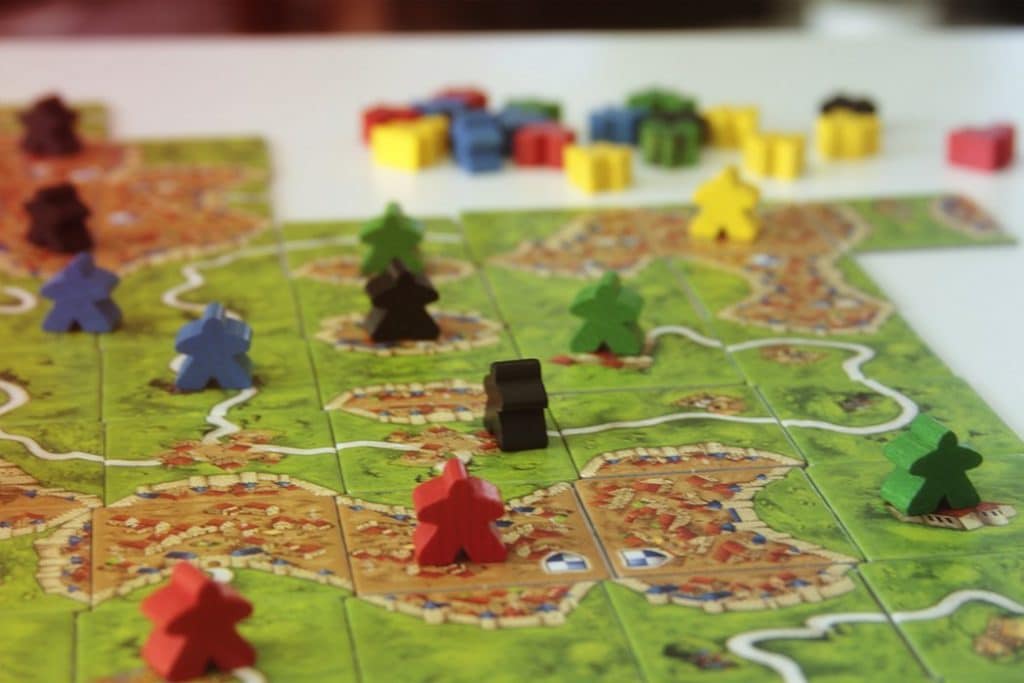
We offer comprehensive game instructions for Carcassonne that include all the important rules and tips. Learn how to skillfully expand your territories, score points, and challenge your opponents.
Carcassonne Game Instructions: Setup and Objective
- At the start, place the starting tile face up. Place the other landscape tiles in face-down stacks at the edge of the table. Each player must have access to them. The scoring tiles are not needed until the final scoring.
- Each player chooses a color and receives all the meeples of that color. Place the scoring board at the edge of the table and place one meeple of each player’s color on space 0 as a counter.
- The goal of the game is to score as many points as possible by building monasteries, roads, and cities, as well as by farming land.
Quick overview of the system and round flow
A game round always consists of three steps: draw a tile, place it, and optionally place a meeple.
- The player whose turn it is first draws a new landscape tile and tries to place it so that it fits the existing board. All adjacent sides must logically match—roads to roads, meadows to meadows, city walls to city walls.
- If a tile cannot be placed, the player may set the drawn tile aside and draw a new one; the mismatched tile is returned to the stack later.
- Next, if possible, the player may place a meeple on the tile just placed. This is followed by the scoring of completed areas. The game continues clockwise.
- As soon as an area is scored—that is, a city, road, or monastery has been completed—the players get their meeples back. This return is important in order to be able to occupy new areas. If meeples remain on open structures for too long, this can limit your options. If players circle the scoring track multiple times during a round, a scoring tile is flipped each time to mark the hundreds place.
Detailed Gameplay of Carcassonne
Carcassonne is played clockwise, with the youngest player starting. Players take turns performing actions and earning points for them.
- First, the player whose turn it is draws a landscape tile and places it adjacent to an existing tile so that roads, cities, and other features connect.
- If a road is shown on the tile, the player may place a meeple on it, provided no other figure is already on another tile along that road.
The same applies to cities, meadows, and monasteries, although monasteries are only depicted on a single tile and are surrounded by meadows.
- If you place a meeple on a meadow, lay it flat for better visibility. The meeples on the fields remain on the tile until the final scoring.
- A road is complete if it ends at both ends in an intersection, a village, a city, or a monastery. The player who owns the meeple on the road receives one point per tile on which the completed road is visible. They may advance this number on the scoreboard and retrieve their meeple.
- A city is considered complete when it is fully enclosed by walls and has no gaps. If a Meeple is then standing on a section, the player receives two points for each tile and two points for each city coat of arms depicted. They may also advance these on the scoreboard and get the Meeple back.
- A monastery is complete when it is directly surrounded by eight tiles. If a player’s meeple is standing on it, that player receives nine points, takes the meeple back, and advances their score on the scoreboard.
- If a street or a city is completed and multiple meeples from different players are standing in it, both players receive the points if the number of meeples is equal. If one player has more meeples in or on it, only that player receives the points.
- When a player has completed the entire scoring track, they receive a score tile and start over at zero.

Examples of Meeple placement and roles in the game
Depending on its position on the board, a Meeple takes on a specific role:
- On roads the Meeple becomes a highwayman, who collects points for completed roads.
- In cities it acts as a knight, who receives points for completed city walls and coats of arms.
- On monasteries the Meeple becomes a monk, who earns points for the monastery and all eight surrounding spaces.
- On meadows it becomes a farmer, which remains in place until the end of the game and earns points for adjacent cities.
End of the Game and Final Scoring
After all tiles have been placed, perform the final scoring, during which points are awarded once more.
- First, each player receives one point per tile for completed roads and cities where one of their meeples is placed, and for cities, also for the coats of arms. For monasteries, the player receives one point for the monastery itself and for each additional tile surrounding it. The scored meeples are removed from the game board.
- Next, all meeples on meadows are scored. The pastures are separated by roads and cities. For each adjacent city, the player receives three points for their pasture. If multiple players have the same number of meeples on a pasture, all of them receive the points. Otherwise, the player with the most meeples on a pasture receives the points.
- Now all points have been scored, and the player with the highest score wins.
- If there is a tie in the final scoring, all players with the highest score win together. Expansions or variants can offer additional sources of points, such as for rivers, cathedrals, or inns that enhance certain structures.
Popular expansions and variants of Carcassonne
Carcassonne has various add-ons that expand the base game and make gameplay more varied:
- Taverns and Cathedrals introduces special tiles that grant additional points for cities and roads, but also make them riskier.
- Merchants and Builders allows players to take double turns and collect goods that grant bonus points.
- River adds a new starting area that makes the layout more varied.