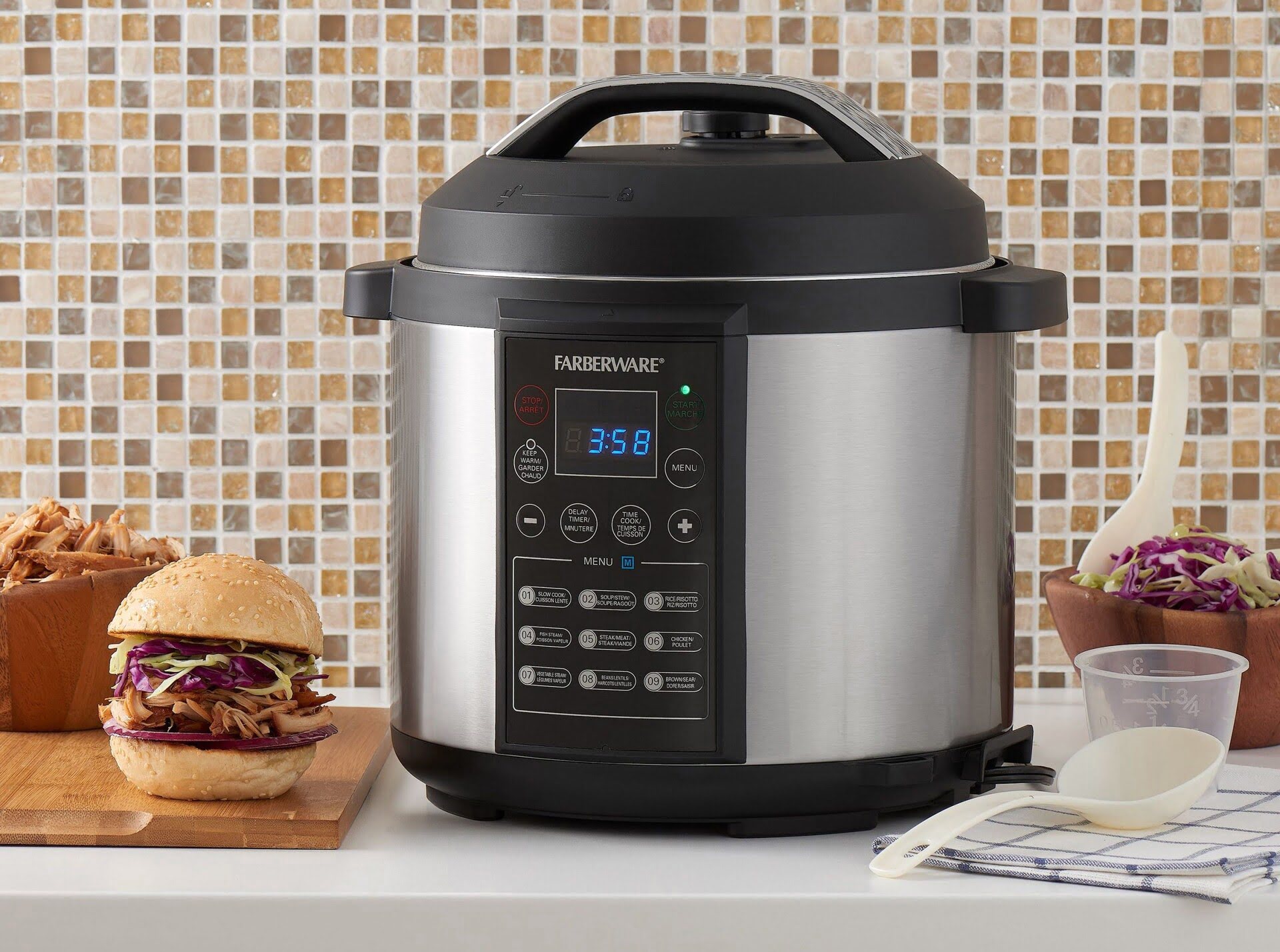
If you don’t have the instructions for your pressure cooker, it’s no big deal. Using a pressure cooker is easy once you know the basics. Cooking with a pressure cooker is recommended because it saves time and preserves nutrients.
How to Start Cooking with a Pressure Cooker: A Guide
If you want to cook with a pressure cooker, first choose the right size for the number of servings you need. Models with a capacity of six liters or more, for example, are suitable for families of four or more. Anything smaller is suitable for smaller households (4.5 l) and single servings (3.5 l).
- Before you start cooking, check that the lid, the inner gasket, and the valves of the pressure cooker are intact. You should also inspect the moving parts for the pressure gauge and the handles.
- Fill the pot with the ingredients. These can be vegetables, fish, or meat. You can place vegetables in a steaming basket that fits the pot; if necessary, lightly brown meat with fat beforehand. Or, following the recipe, add all the ingredients for a stew or soup.
- Next, add the appropriate amount of liquid, which is essential for generating sufficient steam. This also prevents food from burning on the bottom of the pot.
- For small pressure cookers with a capacity of about three liters, add at least 125 milliliters; for medium-sized ones with a four-liter capacity, add about 250 milliliters; and for larger pots starting at six liters, add about 750 milliliters of liquid.
- Overall, you should not fill the pressure cooker beyond three-quarters of its total volume. For foods that foam, are thick, or expand significantly, you should fill the pot to only half its height. This applies, for example, when cooking legumes and stews.
- Now place the lid on and close it so that the handle clicks into place. With most pressure cooker models, you’ll clearly hear and feel this click. Slide the pressure cooker’s latch closed so that pressure can build up inside the pot.
- Place the pot on a stovetop burner that matches the pot’s diameter and turn on the heat. Set the lid to the desired steam pressure level (control knob on the handle).
The cooking time begins with a hissing sound
The cooking time varies depending on how high you let the pressure in the pot rise and what foods you’re cooking. The higher the pressure—level 2 is the highest on most pressure cookers—the higher the internal cooking temperature and the shorter the required cooking time. This preserves vitamins during heating and enhances color and flavor.
- As soon as the steam in the pot builds up pressure, your pot will indicate this. For example, a pin or a type of knob on the lid will rise. This usually has two markings on it.
- At cooking level 1 (the first marking is visible), the food is cooked at about 110 degrees Celsius. This setting is well-suited for delicate foods such as vegetables or fish with a short cooking time.
- Use cooking level 2 (2nd mark) for cooking and braising meat, side dishes such as potatoes, soups, or stews. You can also use it to can or sterilize vegetables or fruit. The temperature at setting 2 is around 120 degrees Celsius.
- Once the temperature and pressure level are reached, you’ll usually hear a slight hissing sound. Now the lid’s valve begins to open to release excess steam. If a significant amount of additional heat is applied, a large amount of steam may escape.
- Now the actual cooking time for your dish begins. You should reduce the heat or turn it off completely by this point at the latest.
- The more experience you have with your pressure cooker and the characteristics of your stove, the more accurately you’ll be able to determine whether you can turn down the heat before reaching the boiling point. This varies considerably from pot to pot and from stove to stove.
Reduce the pressure carefully at the end
For optimal results—especially with vegetables and fish—it’s important to time the cooking period precisely and then lower the temperature in the pot as quickly as possible. Meat, on the other hand, is usually forgiving if the cooking time is slightly exceeded. Once the estimated cooking time has elapsed, reduce the pressure in the pot.
- Move the slider toward “Open Valve.” Caution: Depending on the pressure cooker model—and especially with older models—a large amount of hot steam may suddenly escape. Always make sure no one is standing in the path of the steam.
- Keep in mind: If the steam comes into direct contact with your skin, you risk severe scalding. Additionally, the outside of the pot becomes very hot. Therefore, always use the pot handles when operating it. Continue doing this until no more steam escapes and the pressure indicator has dropped completely.
- You can reduce the pressure and temperature inside the pot fairly quickly by first removing it from the stovetop and running it under cold water. Make sure no water gets into the handle or the valves.
- However, you can also simply wait until the pressure and temperature subside without any further heat source. During this time, though, the contents will continue to cook slightly.
- A DIN standard stipulates that pressure cookers can only be opened once the internal pressure has dropped below four kilopascals. However, there have been cases in the past where cheap products failed to comply with this very safety precaution.
- Once the pressure has dissipated, release the lock on the lid handle. You can now safely open the lid and inspect your food.
- After use, you should carefully wash the lid by hand and thoroughly clean the valves and the sealing ring. Harsh cleaning agents are not suitable for this, as they cause the material to become brittle too quickly. Of course, you can also wash the pot itself and the inserts in the dishwasher.
- Regular and proper care of the sealing rings and valves helps maintain the pressure cooker’s functionality. In addition, cleaning them promptly prevents unpleasant odors and flavors from becoming embedded in the rubber parts.
- To make using the pressure cooker easier, some brands include a replacement valve in the original packaging. This ensures a quick replacement and hassle-free maintenance. However, for the exact placement of the components, it is advisable to consult the manufacturer’s instructions in the user manual, which is usually also available online.

Guidelines for Cooking Times of Various Foods
You’ll quickly gain your own experience regarding how long to cook different foods. Make a note of what yields good or bad results. To start with, you can use the following guidelines:
- Potatoes, Level 2, seven minutes
- Cauliflower, Level 2, three minutes
- Broccoli, Level 1, three minutes
- Fresh green beans, Level 1, seven minutes
- Rice, Level 2, seven minutes
- Goulash, half-and-half, Level 2, 20 to 30 minutes (depending on the amount)
- Lentil soup, speed 2, 15 minutes
- Vegetable soup, speed 1, ten minutes
- Beef soup, speed 2, 30 minutes
Modern Appliances—New Possibilities
Development never stands still, especially when it comes to kitchen appliances. Modern pressure cookers offer additional features and greater safety than older models. Depending on the manufacturer, the following new features are available:
- Some pressure cooker manufacturers minimize the risks associated with a clogged valve by installing two separate pressure relief valves.
- To make it easier to assess the pressure conditions inside the pot, some brands use simple indicator systems, such as a traffic-light color system that shows when the heat should be increased, reduced, or turned off.
- For particularly easy operation, models with a timer integrated into the lid are ideal. These models detect when the required pressure is reached and also take the set cooking time into account.
- Based on the internal pressure measurement and the settings, either an audible signal is emitted or the pressure is automatically reduced and the unit shuts off, ensuring food is cooked to perfection.
- However, you must not confuse steam cooking with cooking in a pressure cooker. Steam cooking also offers several advantages in food preparation, but it is based on simple steam generation without pressure.