338
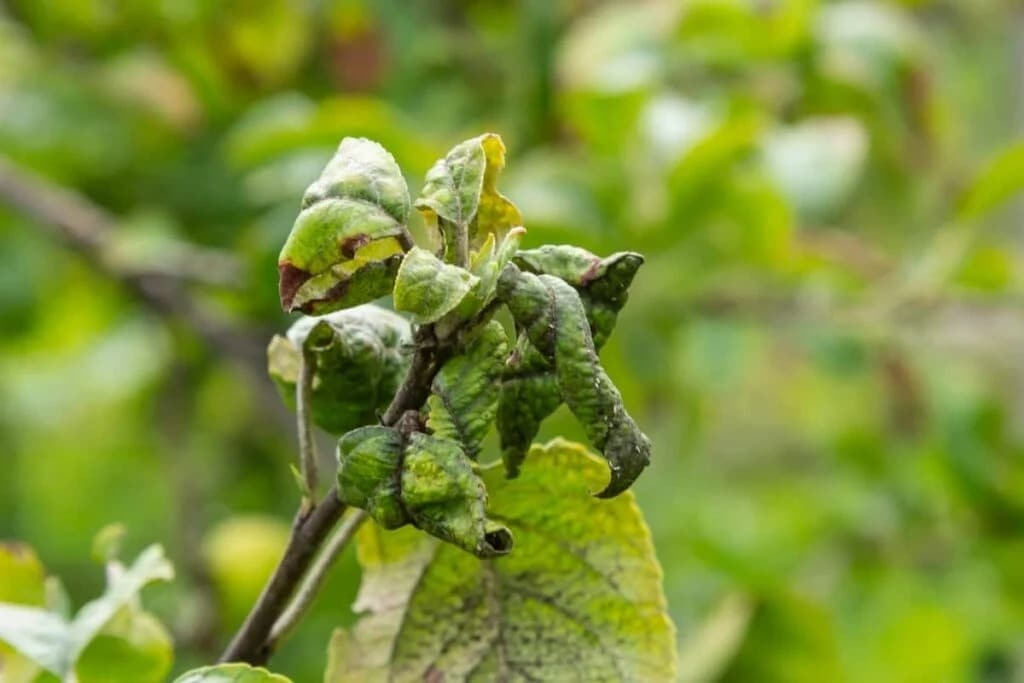
If the leaves on your apple tree are curling, this can be due to both harmless and serious causes that you need to tackle quickly.
Apple tree: why the leaves are curling
If the leaves of your apple tree are curling, there may be both harmless and serious causes behind it. You should therefore quickly check why the leaves are behaving this way.
- Possible causes include drought, disease or pests in your garden, as well as other possible causes such as viral diseases (e.g. apple mosaic virus), nutrient deficiency – especially potassium deficiency – or unintentional herbicide damage, for example due to drift from neighboring beds.
- Pest infestations are usually very easy to detect yourself. Check the leaves for insects and caterpillars, feeding marks, holes, pupae, white deposits or dark spots.
- If you notice any of these signs, a pest infestation is probably responsible for the leaves curling up. In addition to caterpillars and insects, fungi can also be responsible for curling.
- If the leaf shows mosaic-like brightening or irregular mottling, a virus may be the cause. If the leaf edges are yellow-brown and the shoots are weak, this may indicate a lack of nutrients.
- On the other hand, if you do not find any of the above characteristics on the leaves and it has been very dry for a long time, the lack of water may be causing the leaves on your tree to curl;
- If sudden, sharply defined curling occurs without any obvious pests or drought, it is worth taking a look at the possible use of herbicides in the vicinity.
Effective measures: Combating the causes of curled leaves on apple trees
If the leaves of your apple tree have curled up, you can usually do something about it yourself.
- If the leaves curl up due to dryness, you should water the apple tree sufficiently.
- If the phenomenon is not due to drought or a lack of water, you will need to help the tree in other ways. The first step is to remove all affected leaves.
- Ensure that natural enemies of the pests settle in your garden. You can do this by attracting birds, using ladybug larvae or releasing parasitic wasps.
However, a bird-friendly redesign of the garden takes time and is therefore not a short-term solution. - Also ensure an ecological balance in the garden: encourage beneficial insects such as ladybugs, lacewing larvae, hoverflies and earwigs with insect hotels and flowering border strips. These natural enemies often reduce aphid and mite populations more effectively than spraying.
- In the fall, you can attach glue rings to the trunk of your apple tree. These prevent the pests from climbing up the tree. In this way, they protect the tree from pests such as the small frost moth or web moth. This method is not a short-term solution either; the rings must be fitted before a pest infestation occurs.
- If your apple tree is infested with bugs, you can either collect them or shake them off and then collect them from the ground.
- If the leaves are infested with a fungus, you must remove the affected leaves and cut off the branches generously. Do not leave the leaves and twigs in the garden and do not put them in your compost, as the fungus can otherwise spread throughout the garden.
Instead, throw everything well wrapped in a bag into the residual waste. - In the case of viral diseases, it is unfortunately not possible to specifically combat them; the only thing that can help here is to strengthen the tree as a whole and, if necessary, remove heavily infected branches. If the tree shows clear growth disorders or poor fruit quality, it may ultimately be necessary to uproot it;
- As a rule, you can dispense with the use of special plant protection products. However, if you are considering using such products, please note that they may not only affect the pests in question, but also other insects, animals, plants or even your own health.
- After using such products, you must always wash the apples thoroughly before eating them, but it is usually not possible to completely remove pesticide residues in this way.
Prevention: How to keep your apple tree healthy
Good prevention starts with the choice of location and variety of your apple tree.
Some varieties (e.g. Gerlinde, Topaz, Santana or Sonate) are more resistant to scab, aphids or apple powdery mildew.
- Pay attention to a suitable location when planting: apple trees need a sunny, airy place so that the leaves can dry quickly after rain. This effectively prevents fungal infections such as mildew or scab.
- Regular care strengthens the vitality of the tree. This includes targeted pruning, thinning out the crown and ensuring good ventilation. This allows more light and air to reach the inside of the tree, which reduces the risk of fungal infestation.
- Mulching can also help: A layer of grass clippings, compost or chopped wood around the trunk keeps the soil moist, improves the soil structure and supports soil life – this strengthens root health.
- Balanced fertilization is also important. Potassium and magnesium in particular promote the cell stability of the leaves and make them more resistant to pests and stress.