248
Jump-starting a motorcycle can be a temporary solution if the battery is dead or the starter motor is faulty and the motorcycle won’t start. In our practical tip, you’ll learn step by step how to do this safely and effectively.
Jump-starting a motorcycle – What you should keep in mind beforehand
Before you begin, carefully check the following points:
- Fuel level: Make sure there is still enough fuel in the tank.
- Fuel valve (for carburetor models): This must be open so that fuel can flow.
- Fuel pump (for fuel-injection systems): On modern motorcycles, the fuel pump hums briefly after turning on the ignition. If you don’t hear this sound, there may be a problem with the pump or the fuse—in this case, pushing the bike won’t help.
- Emergency stop switch: The switch must be set to “Run” If it is off, the ignition is cut off.
- Side stand: For safety reasons, many motorcycles will not start with the side stand extended—check to make sure it is properly retracted.
- Tip: If you’re having contact issues, it often helps to clean the contacts—dirt can easily accumulate there.
- Gear selection: Select second or third gear – first gear often has too much resistance, which makes pushing the bike harder.
- Safety gear: Always wear appropriate protective gear (helmet, gloves, jacket) even when pushing. Falls can occur even when pushing.
- Choose the right environment: Find a suitable stretch of road, such as a straight or slightly downhill road with a firm surface. The stretch should be at least 40 meters long, and there should be no people, vehicles, or obstacles in the way. It is particularly helpful to have a second person assist with pushing.
Pushing a motorcycle: Step by step
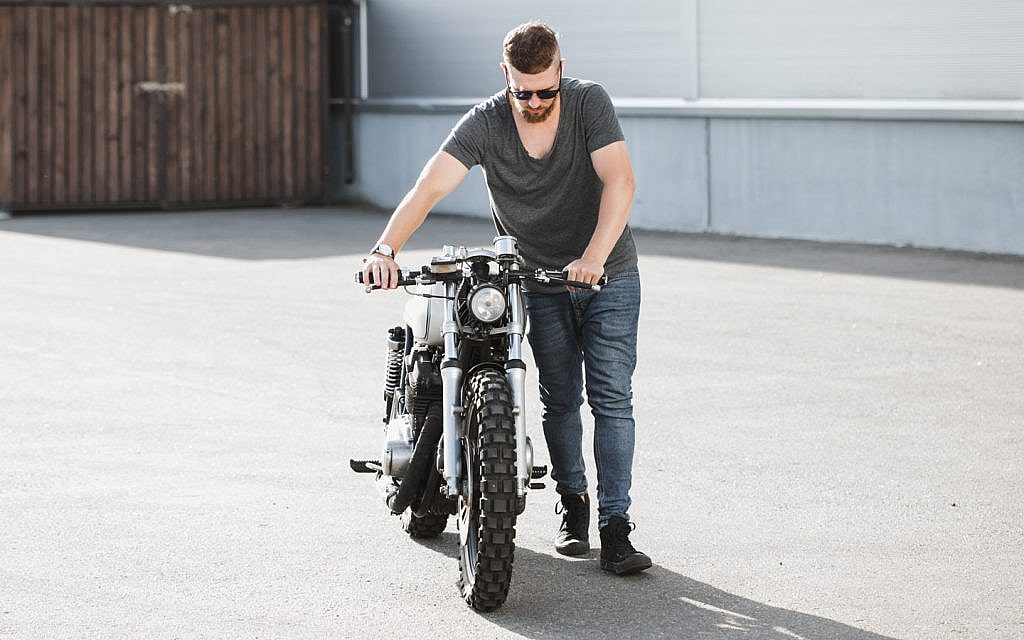
Once all the requirements are met, you can begin the actual push-start. Important: Whenever possible, someone should be sitting on the motorcycle—this increases control and significantly reduces the risk of an accident. A second person can help with the push-start, or you can use a slightly downhill stretch to gain momentum.
- First, turn on the ignition. Make sure the emergency stop switch is set to “Run” and shift into second or third gear – first gear is usually too low a gear ratio and makes starting difficult. Now pull the clutch all the way out and hold it there.
- As soon as you get a push or start rolling down a hill, make sure you have enough speed. Ideally, you should reach about 8 to 12 km/h – that’s roughly the speed of a brisk jog.
- Once you have reached this speed, release the clutch abruptly . You should feel a strong jolt through the motorcycle—this is normal, as it mechanically sets the engine in motion.
- When the engine starts, immediately pull the clutch back and gently give it a little gas – this prevents the engine from stalling right away. In many cases, a quick burst of gas is enough to keep the engine running steadily at idle.
- Now let the engine run for a while at idle or take it for a short ride to recharge the battery a bit. If the motorcycle stalls again immediately after being pushed, this may indicate a deeply discharged battery or another technical issue that should be investigated further.
- Important note: Pushing the bike should only be a temporary solution &n (e.g., defective battery, defective starter) fixed at a repair shop as soon as possible to avoid consequential damage – especially in fuel-injected models, frequent pushing can damage the catalytic converter system or the control unit.

When pushing doesn’t work:
Pushing works not on all motorcycles:
- Automatic transmissions (e.g., many scooters) cannot be pushed.
- Motorcycles with a severely discharged battery and an electronic immobilizer or fuel injection system that does not start up often won’t start because the electronics aren’t getting enough power.
- In the case of defects in the ignition or fuel supply (e.g., defective fuse, control unit), pushing the bike also does not help.