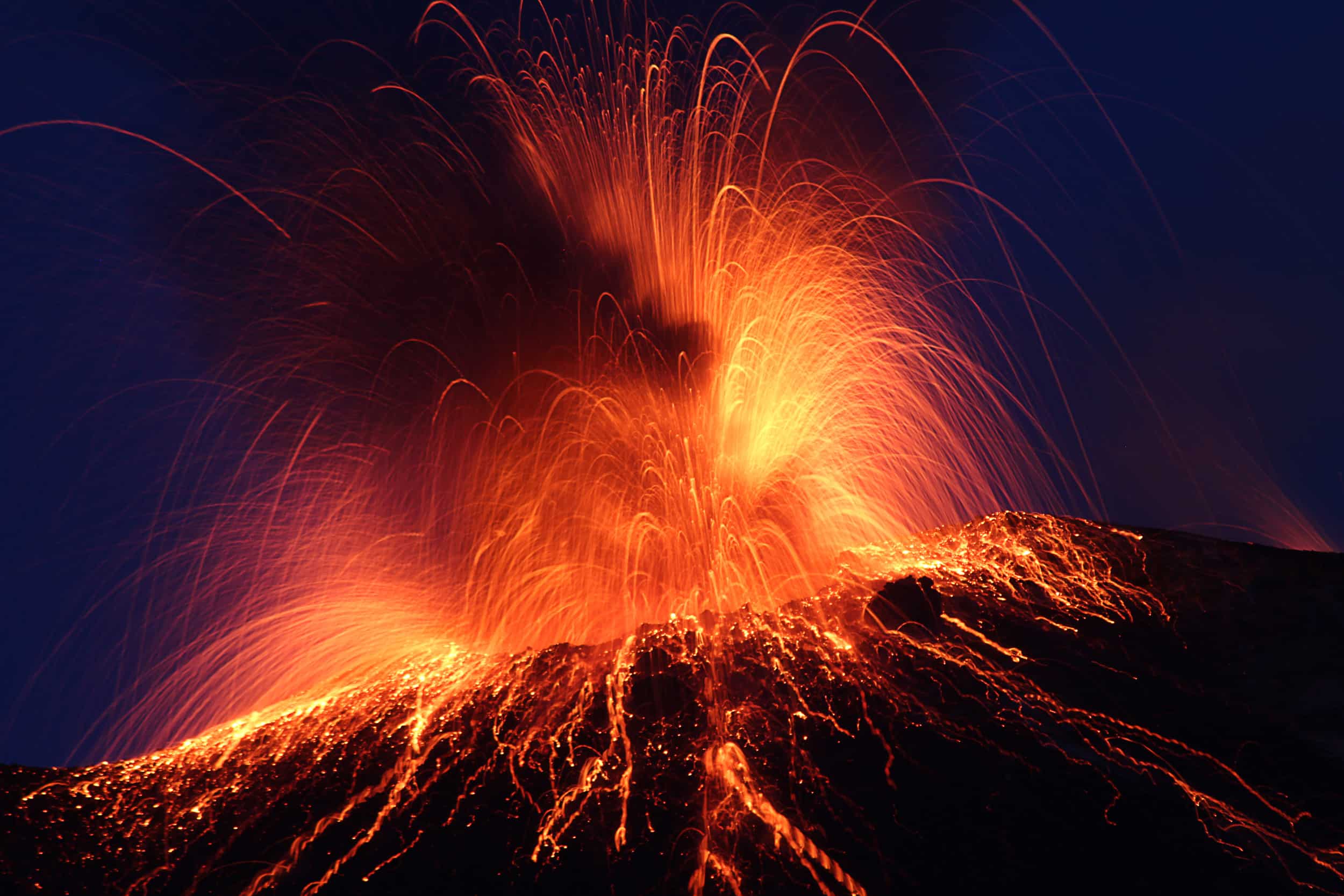
Volcanoes can be classified into several types based on their shape, activity, and location. The risk of an eruption varies depending on the type.
Types of Volcanoes by Shape
Based on their external shape, the following types of volcanoes are distinguished:
- Caldera: If the magma chambers near the surface are emptied during a volcanic eruption, the volcano sometimes collapses inward—creating a bowl-shaped volcanic crater known as a caldera. Well-known calderas: Krakatoa (Indonesia), Yellowstone Caldera (USA), the Santorini archipelago (Greece).
- Lava-dome or plateau volcano (also called a trapp): Low-viscosity, basaltic lava (flood basalt) reaches the surface and forms stepped domes. These events are often associated with massive, sudden lava flows that can cover large areas. Examples: Deccan Trapp in India, Siberian Trapp, the Columbia Plateau Basalt (USA).
- Lava dome (plug, volcanic dome): When viscous lava cools rapidly, lava domes (which look like hills) or lava needles (columnar) sometimes form directly above the volcanic vent. The Chaîne des Puys (France) is an area with many lava domes.
- Maar: Steam explosions can occur when hot magma and groundwater come into contact. After the explosion, funnel- or bowl-shaped craters, known as maars, are formed. Examples: Over 70 water-filled or dry maars in the Vulkaneifel (Germany).
- Stratovolcano: Flowing lava and loose material cool and form layers. This creates volcanoes (which grow taller with each eruption) that have a pointed, steep conical shape. Examples: Vesuvius and Etna (Italy), Mount St. Helens (USA).
- Shield volcano: Low-viscosity lava flows farther than in a stratovolcano—thereby forming a flat, shield-like formation. Shield volcanoes are usually non-explosive and extend over large areas. Examples: Mauna Loa (Hawaii), Olympus Mons (on Mars, the largest known shield volcano in the solar system).
- Cinder and ash cones: Small volcanoes consisting of deposits of volcanic material. They are cone-shaped and have a blunt tip. They often form on the slopes of larger volcanoes.
Example: Paricutín (Mexico), cinder cones around Mount Etna (Italy).
- Plate volcano: Forms when lava reaches the Earth’s surface through a glacier or an ice sheet. When the ice melts, a volcano with steep walls and a flat summit remains. Example: Brown Bluff (Antarctica).
Classification by location
Depending on their location, the following types of volcanoes exist:
- Subaerial volcanoes: on land, above water. Examples: Etna, Vesuvius
- Submarine volcanoes (seamount, guyot): in the sea/ocean, underwater. These can also give rise to islands (e.g., the island of Surtsey). Example: the Kolumbos volcano in the Mediterranean
- Subglacial volcanoes: under ice, under a glacier. Example: Mount Fuji (Japan)
- Extraterrestrial volcanoes: not on Earth, but on other celestial bodies. Examples: Volcanoes on Mars, on Jupiter’s moon Io, Saturn’s moon Enceladus, and Neptune’s moon Triton
Active or inactive?
However, many volcanoes do not follow a “pure” eruption pattern, but exhibit varying behavior either during an eruption or over the millions of years of their activity. An example of this is Mount Etna in Sicily.
- Active volcanoes can erupt at any time. Examples: Etna, Vesuvius (Italy), Kilauea (Hawaii), Eyjafjallajökull (Iceland), Popocatepetl (Mexico)
- Inactive or dormant volcanoes are no longer active, but they could become active again.
- Extinct volcanoes: These volcanoes no longer have a magma supply and can no longer erupt. However, it is very difficult to scientifically prove that a volcano is extinct—most are likely just inactive. Example: Volcanoes on the island of Gran Canaria

Types of Volcanoes by Activity Type
Not only the frequency of eruptions is important for classifying volcanoes, but also the way in which they occur:
- Supervolcanoes: These volcanoes have a larger magma chamber, and a massive explosion occurs when they erupt. A cone-shaped volcano does not form; instead, a caldera is created. Example: Yellowstone (USA)
- Volcanoes with explosive or ejective activity: There is an explosive ejection of magma and rock, releasing gases.
- Volcanoes with effusive activity: Lava flows calmly from the crater; there is no explosion.
- Volcanoes with mixed effusive and explosive activity: Volcanoes that exhibit both explosions and effusions.
Types of volcanoes based on the type of magma supply system
Another classification is based on the type of magma supply system:
- Central volcanoes are isolated within a volcanic system and are fed by a central, tubular conduit . Examples: Etna, Vesuvius
- Fissure volcanoes do not have a central vent; the lava flows from fissures. Example: Mount Tarawera (New Zealand)