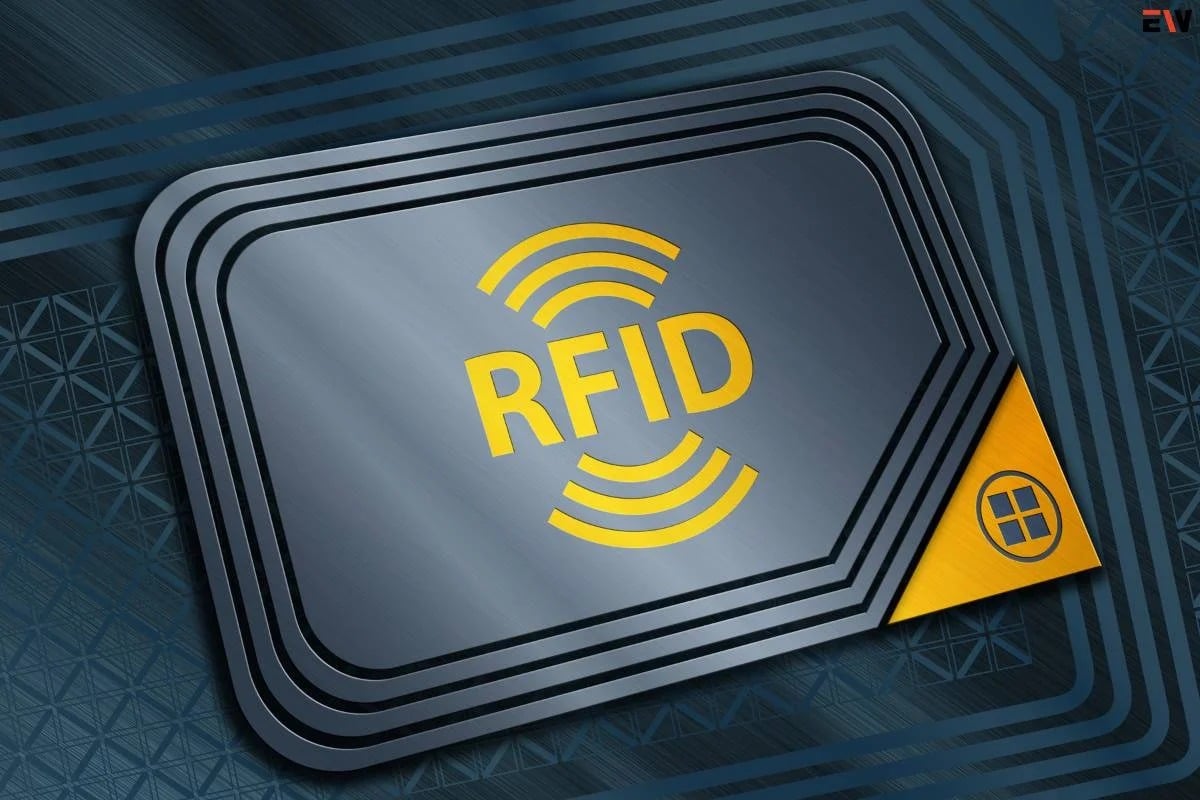
The abbreviation RFID isn’t immediately obvious. Yet it’s important to know what lies behind those four letters: Radio Frequency Identification.
Radio Frequency Identification: RFID Explained
RFID is a method of identification using electromagnetic waves.
- A wide variety of information can be stored on a small RFID chip. A reader can retrieve the data at any time via radio waves.
- The stored data can consist of plain text or simple codes. Numbers, names, passwords, and numerous other types of information can be stored.
- RFID chips are also referred to as transponders or tags. RFID chips are now mass-produced items that cost only a few cents.
The technology behind RFID: All the information at a glance
Not all RFID is the same. Depending on the manufacturer and intended use, the operating principles and transmission frequencies used vary. However, the structure of RFID transponders is always the same: Each transponder consists of an antenna, an analog circuit for sending and receiving data, a digital circuit, and a memory.
- There are both passive and active transponders. Active transponders have their own battery or rechargeable battery and therefore have a limited lifespan. In return, the distance to the reader can be several meters.
- Passive transponders do not have a battery and draw their energy directly from the reader’s energy field. As a result, RFID tags function for an almost indefinite period, though only over short distances.
- Due to their small size, often only a limited amount of data can be stored on RFID tags. However, typically only a small amount of information is stored in the form of text or short codes.
Technical Basics and Frequencies
RFID systems operate in different frequency ranges, which directly influence range, data rate, and area of application:
- The low-frequency (LF) range covers frequencies from 30 to 300 kilohertz and is usually operated at 125 or 134.2 kilohertz. Such systems have a short range of up to about ten centimeters but are relatively insensitive to materials such as metal or water. For this reason, they are frequently used for animal identification or in access control.
- The high-frequency range (HF) lies between 3 and 30 megahertz and, in practice, operates predominantly at 13.56 megahertz. This technology enables ranges of up to one meter and is particularly suitable for smart cards, library systems, and electronic ID documents.
- The Ultra-High-Frequency (UHF) band covers 300 megahertz to 3 gigahertz and typically operates between 860 and 960 megahertz. Such systems achieve ranges of up to ten meters and are ideal for use in logistics, inventory tracking, and toll systems.
- There are also RFID applications in the microwave range, which operate at 2.45 or 5.8 gigahertz, for example. These enable very high data rates but are more sensitive to environmental influences.
- Transponders can be divided into different types. Read-only tags are programmed once and can subsequently only be read, but not modified.& nbsp;Read/Write tags allow stored data to be changed or supplemented at any time. Semi-passive transponders have their own battery for the memory, but only transmit when they are within the active field of a reader.

RFID: Where the technology is used
RFID was already in use during World War II. Tanks and aircraft were equipped with transponders to distinguish between friend and foe.
- Starting in the 1960s, RFID was also used in industry. Parts for trains and cars were fitted with RFID tags for accurate identification.
- Since the 1970s, RFID has also become common in everyday life. To prevent theft, alcohol and clothing are still fitted with RFID tags today. At the checkout, the RFID chips are deactivated or destroyed by a strong magnet.
- Since the 1980s, RFID has also been used in agriculture. Cows and other farm animals were given an ear tag with an RFID chip for identification.
Nowadays, many dogs and cats are also implanted with a microchip for identification.
- In the new passport and ID card, some information is stored on an RFID chip. Debit cards, ski passes, electronic immobilizers, and toll systems also use RFID.
- The idea of RFID chips in banknotes has also been considered, but so far, such projects have failed due to cost.
- Meanwhile, almost every modern smartphone uses RFID in the form of NFC (Near Field Communication), an advanced RFID technology for short-range applications, such as contactless payment.
Software, Data Management, and Integration
Modern RFID systems are increasingly controlled by specialized software. This software not only reads the tags but also analyzes and links the collected data in real time.
- Middleware connects RFID readers to existing IT systems such as ERP or warehouse management systems.
- Data management plays a central role: millions of RFID read operations must be filtered, stored, and managed in a traceable manner.
- Cloud-based applications enable cross-location analyses and integrations with IoT platforms.
Benefits at a Glance
A key advantage of RFID technology is that data exchange is contactless. This allows information to be transmitted quickly and efficiently without requiring direct contact between the transponder and the reader.
- The automatic tracking of objects or people significantly reduces the workload, leading to considerable time and cost savings. In logistics in particular, the use of RFID systems can optimize processes and minimize labor costs.
- Another advantage is the low error rate. Since tracking is automatic, manual input errors are largely avoided. This significantly increases the accuracy of inventory or production data.
- RFID also improves traceability in supply chains. Companies can track the location and status of individual products in real time, thereby making processes more transparent.
Security and Data Protection Aspects
With the growing prevalence of RFID systems, the risks of misuse and unauthorized access to stored data are also increasing.
- One of the greatest dangers is so-called “skimming,” in which unauthorized individuals attempt to secretly read RFID chips from close range. This can result in sensitive information, such as personal data or access codes, falling into the wrong hands.
- To minimize such risks, various protective measures are employed. Shielding sleeves for ID cards or credit cards, for example, prevent stored information from being read without permission.
- Modern RFID chips are often equipped with encryption technologies that allow access only to authorized readers.
- Additional technical methods, such as the so-called “kill command,” which can permanently deactivate a chip. Another approach involves “blocker tags,” which prevent unauthorized reading by emitting a kind of jamming signal.
- In addition to technical measures, legal regulations also play a crucial role. In the European Union, the General Data Protection Regulation (GDPR) ensures that personal data must be collected and processed in accordance with clearly defined guidelines.
- Companies that use RFID are required to transparently disclose the purpose of data collection and ensure adequate security measures.