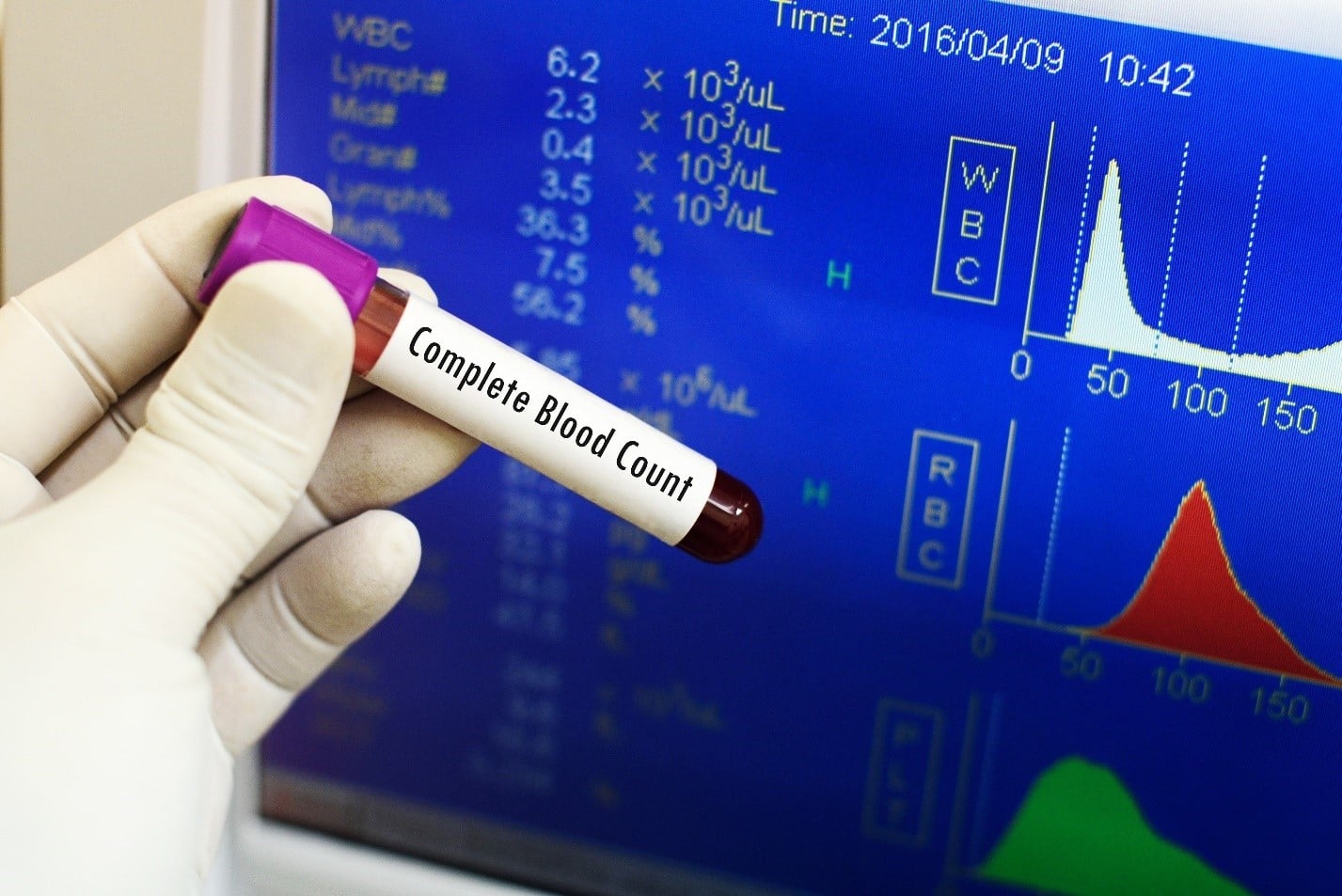
When a doctor orders a complete blood count, we as laypeople often don’t know what all the test results mean. First off, it’s important to note that there is no one-size-fits-all answer to this rather broad question. Here, however, you’ll learn what the results indicate and what possible causes there might be.
Collecting Values for a Complete Blood Count
The first question that comes to a patient’s mind when the doctor orders a complete blood count—also known as a differential blood count—is when a complete blood count is even performed.
- Normally, the doctor always starts by ordering a complete blood count (CBC).
- If abnormalities are found in the CBC, the doctor requests the necessary tests for a differential blood count from the lab.
- In rather rare cases, a differential blood count is ordered directly, for example, if inflammation in the body is suspected or if there is suspicion of a blood disorder.
- In addition, other blood tests are usually ordered based on the patient’s symptoms.
These lab results are determined
The next question patients ask is which values are actually measured in a complete blood count.
- First of all, the complete blood count includes the same parameters as the basic blood count. The basic blood count includes red blood cells, white blood cells, platelets, hemoglobin, and hematocrit, as well as MCV, MCH, and MCHC.
- In a complete blood count, the various types of white blood cells are also broken down. These include neutrophils, eosinophils, and basophils, as well as monocytes and lymphocytes.
- The test looks for abnormal cell shapes and the percentage and absolute count of these cells.
- Contrary to popular belief, you do not need to fast for this blood draw. However, since other values are often measured as well, you may not be allowed to eat or drink anything beforehand—this is the case, for example, when blood sugar or blood lipid levels are being measured.
The values of the complete blood count
First, the values of the complete blood count are examined; if abnormalities are found, additional tests are performed. But what exactly are these values?
- Erythrocytes: Red blood cells float freely in the blood and are responsible for transporting oxygen from the lungs to the organs and for returning carbon dioxide. They also perform active metabolic functions.
- Hemoglobin: This red blood pigment is found in erythrocytes and also plays a role in transporting oxygen and carbon dioxide.
- Hematocrit: Indicates the percentage of erythrocytes in the total blood volume. The normal range is approximately 36–47%.
- Leukocytes: White blood cells are divided into granulocytes, monocytes, and lymphocytes. Their general function is to destroy pathogens.
- Thrombocytes: Platelets are involved in the blood clotting process. They also seal the vessel walls in the event of blood vessel injuries.
- MCV: Is the mean corpuscular volume of a red blood cell.
- MCH: The mean hemoglobin concentration in a red blood cell.
- MCHC: The mean hemoglobin concentration in all red blood cells.

Additional laboratory values in the differential blood count
The complete blood count provides a more detailed breakdown of the various types of leukocytes. Based on these values, along with the patient’s symptoms, the doctor can often make an accurate diagnosis.
- Neutrophils: These are microphages, meaning they are phagocytes that engulf pathogens. When faced with a massive influx of bacteria and viruses, they disintegrate after engulfing them and become a component of pus. The normal range is approximately 14–75%. They are further subdivided into the subtypes immature neutrophils (normal range: 0–1%), band neutrophils (normal range: 3–5%), and segmented neutrophils (normal range: 50–70%).
- Eosinophils: They play a role in cellular immune defense and are more prevalent during allergic reactions. Their normal range is approximately 0–6%.
- Basophilic granulocytes: Their normal range is 0–2%; they are also involved in the body’s immune defense and contain granules that hold histamine, serotonin, and heparin.
- Monocytes: These large phagocytes, known as macrophages, engulf pathogens and foreign substances that the microphages cannot handle on their own. They can transform into new tissue when disease-related tissue damage has occurred and are involved in the production of antibodies. Their normal range is 5–12%.
- Lymphocytes: They develop in the fetal bone marrow; after birth, they are produced in the lymph nodes, tonsils, spleen, thymus, and appendix. They are involved in the antigen-antibody reaction and are particularly elevated in viral infections. Their normal range is approximately 12–70%.
Changes in the complete blood count—possible causes
Although a diagnosis must always be made by a doctor —since the medical context is too complex for you, as a layperson, to fully understand on your own—here is a brief overview of what an elevated or decreased value might indicate.
- Neutrophils: Indicate inflammation, certain hormonal disorders, or may be altered when taking certain medications.
- Eosinophils: May indicate allergies, parasitic infestations, or possibly leukemia or lymphoma.
- Basophils: May indicate a blood cancer.
- Lymphocytes: Primarily indicate viral infections, but can also provide insights into autoimmune diseases and protein-deficient malnutrition.
- Monocytes: Provide clues about infectious diseases and autoimmune disorders.
- Platelets: May indicate iron-deficiency anemia, acute infectious diseases, bleeding, and chronic inflammation, as well as antibody reactions and coagulation disorders.
- Hematocrit: Often indicates lung diseases, dehydration, or chronic renal failure.
- Hemoglobin: This value can also be used to detect lung diseases and dehydration, as well as iron or vitamin B12 deficiency or chronic diseases.
- Red blood cells: The count may indicate iron or vitamin deficiency, rheumatic diseases, infections, or various heart or lung diseases.