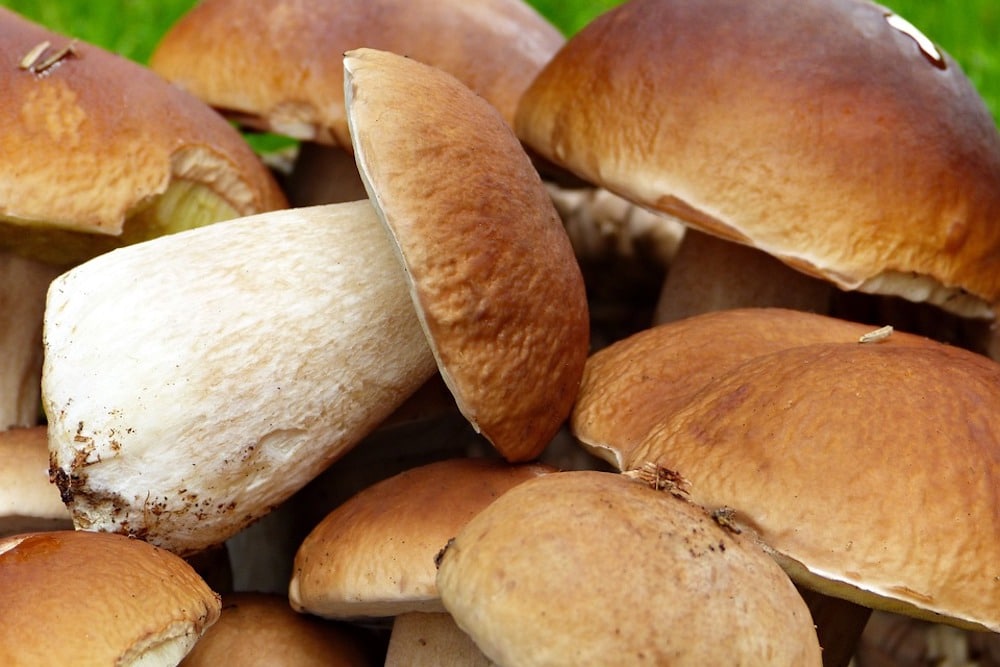
Almost everyone knows the porcini mushroom – at least by name. However, there is a risk of confusion with two other types of boletus. Here we explain what they are and what the differences are.
Features of the porcini mushroom – how to avoid confusion
If someone draws a mushroom, it usually looks like the Boletus edulis. Its appearance corresponds to the “typical mushroom”. However, there are actually species with which it can easily be confused. You can recognize porcini mushrooms by the following characteristics:
- The porcini mushroom, also known as the man’s mushroom, grows throughout Europe, preferably in coniferous and mixed forests.
- The boletus is a tubular mushroom – also known as a boletus. This means that on the underside of the mushroom cap you can see fine pores, which are the end of small tubes in which the spores of the mushroom are located. This “mushroom tissue” resembles the structure of a sponge.
- The cap of the porcini mushroom measures around 4 centimetres in diameter in young specimens. In adults, it can grow up to 25 centimetres in size.
- You can recognize the porcini mushroom by its cap, which is covered by a brown leathery layer. Under this – typical of the porcini mushroom -is a reddish-brown color zone. The edge of the cap is slightly rolled and forms a white ring.
- The underside of the cap is white to cream-colored in young porcini mushrooms. In older mushrooms, it turns a light yellow-greenish color.
- The cap of the porcini mushroom sits on a cylindrical to thick-bulbous stem, which can be 5-15 centimetres high. You will recognize a mostly elongated, beige-brownish to golden-brown grain, which is more pronounced towards the cap and barely present towards the mycelium.
- Also typical of porcini mushrooms: If you press the mushroom, you will notice that it is quite firm and not very sensitive to pressure.
- The smell and taste of porcini mushrooms is typically “mushroom”. It’s no wonder that it is judged this way, as it gives numerous well-known dishes their unmistakable mushroom aroma.
- Unfortunately, porcini mushrooms are often the victims of maggot damage. These create holes and wormholes within the mushroom flesh. However, not only porcini mushrooms are affected, but also similar varieties.
It is therefore important to clean them carefully before eating porcini mushrooms. You should then check that the mushroom is still good and not moldy. - Picking porcini mushrooms may seem like a lot of work at first, but it is almost the only way to get your hands on these tasty mushrooms.
The gall bolete – not poisonous but inedible
It is particularly easy to confuse the porcini mushroom with the bitter boletus (Tylopilus felleus), especially when it is still young. The older specimens are already more clearly distinguishable from each other. You should keep the following in mind when picking mushrooms
.
- The gall fungus also prefers to grow in coniferous and mixed forests.
- Optically, it looks similar to the porcini mushroom, but the cap of the gall fungus is covered with a somewhat finer brown skin, which is not as leathery as that of the porcini mushroom.
- In older mushrooms, the cap is also curved more strongly upwards. In the porcini mushroom, this curvature is somewhat flatter;
- You can also discover a significant difference on the underside of the cap, which is particularly noticeable in larger specimens: the sponge-like flesh of the tubes is slightly pink in color;
- You will also notice this when you apply pressure: The flesh is sensitive to pressure and the discoloration of the sponge increases.
- If you look at the light brown stem of the mushroom, you will recognize a dark net-like structure that is clearly different from the porcini mushroom.
- Markant: As soon as just one gall bolete ends up in your meal, you will notice it, because with its bitter substances it literally denatures the taste.
- Though the mushroom is not poisonous, it is clearly inedible.

Tasty chestnut mushroom
An edible and tasty competitor to the porcini mushroom is the chestnut boletus (Boletus Badius), also known as the brown cap or brown bolete. You can easily confuse the two mushrooms.
- The preferred location of brown caps is coniferous forests, preferably near larch trees.
- The brown cap of the chestnut bolete, like that of the gall bolete, lacks the leathery firmness.
It is rather velvety brown in color; - The underside of its cap is yellow to olive-yellowish and is difficult to distinguish from the porcini mushroom when undamaged.
- Typically, however, if the spongy tissue turns blue-greenish when pressed, it is probably a chestnut mushroom.
- Altogether typical: The entire flesh of the mushroom “turns blue” when cut open or injured. In other words, it turns blue. Overall, the mushroom is also much softer than the porcini mushroom.
- The stalk of the chestnut mushroom is about the same as the porcini mushroom, 5-15 cm high, cylindrical to bulbous in shape. It is brownish in color and has an ingrown grain that is not as net-like as that of the gall fungus.
- Health authorities report concerns regarding consumption, as the chestnut mushroom is a radioactive collector. Occasional consumption is possible, but children, pregnant women and breastfeeding mothers are advised against it.
- You will notice another difference when eating them: the aroma of chestnut mushrooms is somewhat “nuttier” than that of porcini mushrooms. It is ideal as a dried mushroom for seasoning in the kitchen.